



People living with obesity face negative attitudes, stereotypes, and blame from others because of their weight (i.e., weight bias). Weight bias can be explicit, such that an individual is conscious of negative attitudes (i.e., blatant), or it can be implicit, where the person is unwilling or unable to admit these attitudes (i.e., unconscious). Weight bias is partly driven by the inaccurate belief that weight is entirely within an individual’s control. This conceptualization ignores the complex genetic, biological, social, financial, environmental, and behavioral factors contributing to obesity.10
American Diabetes Association’s Standards of Care in Overweight and Obesity
Weight stigma
Weight bias contributes to weight stigma, or the social devaluation and mistreatment of individuals based on weight or size that may include:
-
Discrimination
- Ignoring.
- Excluding.
- Weight-discriminatory policies.
- Employment and education discrimination.
-
Stereotyping
- Presumed to be lazy.
- Incompetent.
- Lacking willpower.
-
Social exclusion
-
Teasing, bullying, harassment, microaggressions
While people across the weight spectrum can experience weight stigma, it is most often directed toward people living with obesity.10, 11 Weight stigma occurs in various settings (e.g., education, health care, workplace, home) from many sources including friends, family members, healthcare professionals, and internalized negative weight attitudes.5, 11
Watch the video below (2:19 min.) for more information about weight stigma, its effects, and what you can do about it.
Internalized weight stigma
Watch the video below (2:29 min.) to learn why internalized weight stigma can make weight management harder.
Healthcare professional weight bias and stigma prevalence
question
What percentage of healthcare professionals and trainees report biased attitudes against people living with obesity?
Between 40 and 70% of healthcare professionals report biased attitudes against people living with obesity and have used stigmatizing descriptors such as:
- Lazy.
- Stupid.
- Non-compliant.
- Lacking willpower.
- Undisciplined.
While healthcare settings aim to be health supportive, unbiased, and patient-centered, empirical studies over a 40-year period show that people living with obesity experience weight stigma and discrimination from HCPs. Weight stigma and bias are highly prevalent among healthcare professionals, and research consistently finds them among practitioners and learners. Between 40 and 70% of healthcare professionals report biased attitudes against people living with obesity and describe people living with obesity as “lazy, stupid, non-compliant, lacking will-power and undisciplined.” Negative attitudes regarding people living with obesity are even reported by healthcare professionals specializing in obesity.10, 11
While prevalence varies by profession and measurement method, research reviews have reported that:
-
More than half of healthcare professionals in many studies endorse negative stereotypes about people with obesity.11, 12
-
Substantial proportions of healthcare professionals endorse assumptions that patients with obesity lack motivation, are nonadherent, or have poor self-control.12
-
Large-scale implicit bias datasets show that healthcare professionals frequently demonstrate an automatic preference for thin individuals over larger-bodied individuals, indicating widespread implicit bias.12, 13
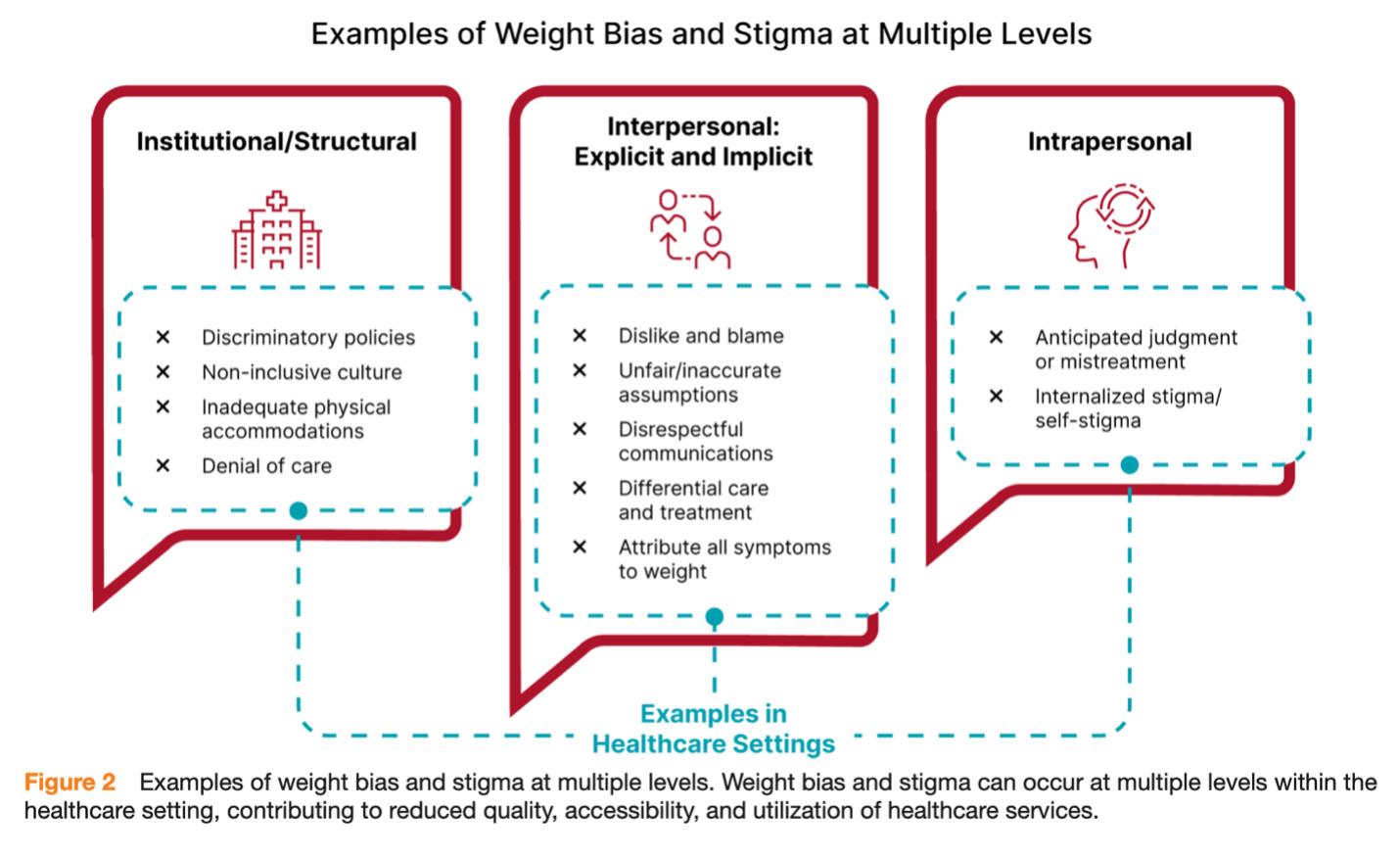
The following figure provides examples of weight bias and stigma at multiple levels in the healthcare system.
question
True or False: Weight stigma impacts psychological health, but not physical health, of patients.
- Psychological effects include:
- Increased depression.
- Anxiety.
- Low self-esteem.
- Body dissatisfaction.
- Disordered eating.
- Social isolation.
- Physical effects include:
- Increased physiological stress.
- Elevated cortisol levels.
- Avoidance of healthcare.
- Delayed preventive care.
- Reduced physical activity.
- Disordered eating behaviors.
- Weight gain over time.
- Poorer overall health outcomes.
- Research suggests that experiencing weight stigma is associated with increased morbidity and mortality, independent of BMI.
- Weight stigma is associated with lower quality of care, including:
- Less patient-centered communication.
- Reduced compassion and rapport.
- More directive care approaches.
- Patients who experience weight stigma are more likely to delay or avoid healthcare, report lower trust in providers, and engage in “healthcare professional shopping.”12, 14
- In terms of health outcomes, patients who experience weight stigma from their healthcare professionals experience:
- Worse physical health.
- Poorer mental health.
- Delayed care.
- Potentially higher mortality.10, 12, 15–18
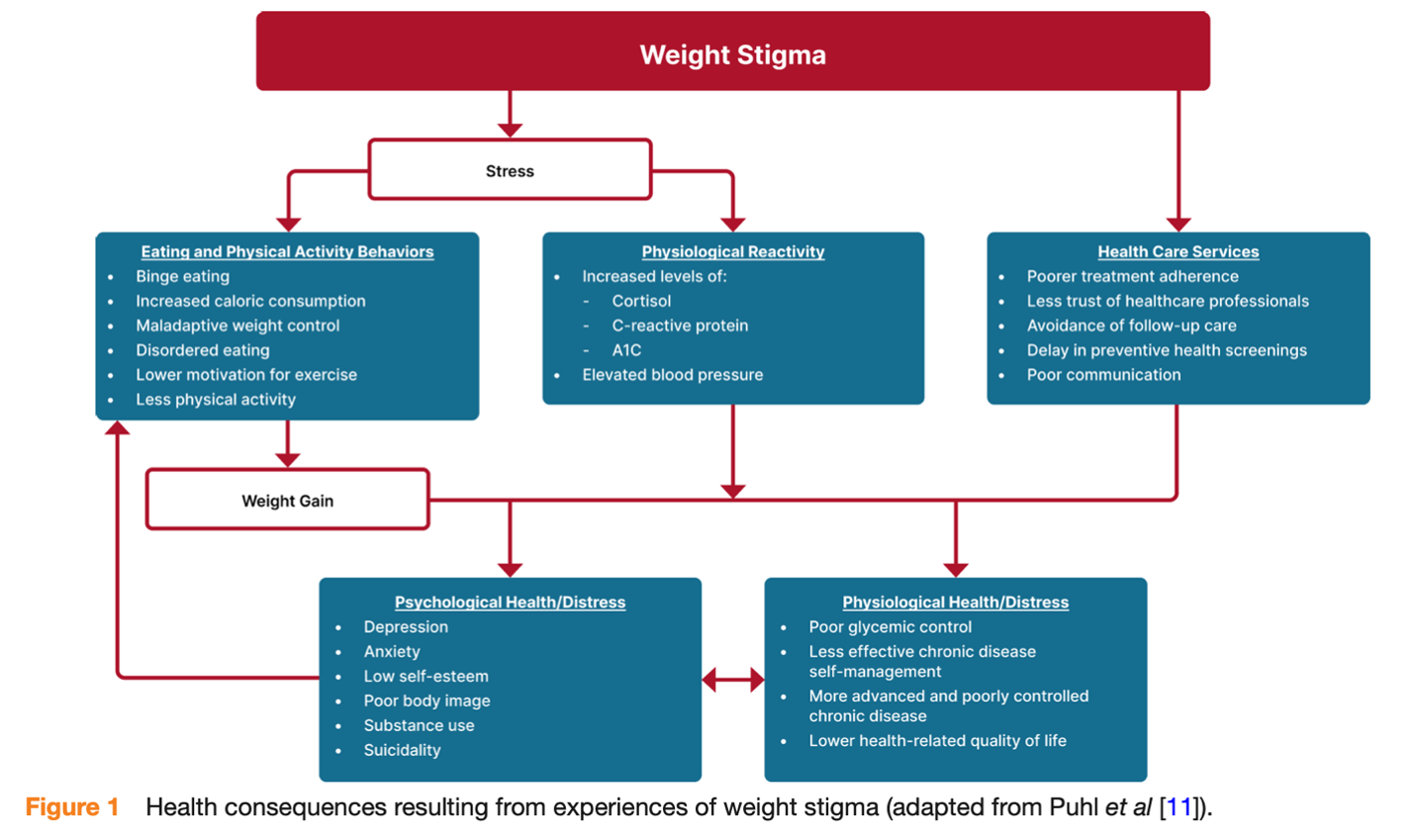
The following flowchart describes health consequences resulting from experiences of weight stigma.
think about this
How might weight bias or assumptions about body size influence interactions, clinical decisions, or patient outcomes within your profession?
- Lim Y, Haq N, Boster J. Obesity and Comorbid Conditions. StatPearls. Treasure Island (FL): StatPearls Publishing. StatPearls Publishing LLC.; 2026.
- DeCleene NK, Kahn E, Yuan CW, Gakidou E, Mokdad AH, Murray CJL, et al. U.S. State-Level Prevalence of Adult Obesity by Race and Ethnicity From 1990 to 2022 and Forecasted to 2035. JAMA. 2026;335(11):975-85.
- Obesity in Washington. Foundation UH 2024;Pages. Accessed at America’s Health Rankings on August 5 2026.
- Podolsky MI, Raquib R, Hempstead K, Stokes AC. Trends in Obesity Care Among U.S. Adults, 2010–2021. Med Care. 2025;63(3):234–40.
- Obesity Management Learning Hub. American College of Physicians. 2026 Accessed on July 8 2026.
- Masood B, Moorthy M. Causes of obesity: a review. Clin Med (Lond). 2023;23(4):284–91.
- Busebee B, Ghusn W, Cifuentes L, Acosta A. Obesity: A Review of Pathophysiology and Classification. Mayo Clinic Proceedings. 2023;98(12):1842–1857.
- Singh V, Sun J, Cheng S, Kwan AC, Velazquez A. Obesity as a Chronic Disease: A Narrative Review of Evolving Definitions, Management Strategies, and Cardiometabolic Prioritization. Adv Ther. 2025 Nov;42(11):5341–5364.
- Dancause KN, Olszowy KM. Identifying actionable lifestyle risk factors for obesity research and intervention: Challenges and opportunities for Pacific Island health researchers. The Lancet Regional Health—Western Pacific. 2020;4.
- Bannuru RR. Weight stigma and bias: standards of care in overweight and obesity—2025. BMJ Open Diabetes Research & Care. 2025;13(Suppl 1):e004962.
- Brown A, Flint SW, Batterham RL. Pervasiveness, impact and implications of weight stigma. eClinicalMedicine. 2022;47:101408.
- Phelan SM, Burgess DJ, Yeazel MW, Hellerstedt WL, Griffin JM, van Ryn M. Impact of weight bias and stigma on quality of care and outcomes for patients with obesity. Obes Rev. 2015;16(4):319–26.
- Liang JW, Buonpane C, Wang S, Salles A. Implicit and explicit weight bias among healthcare professionals. International Journal of Obesity. 2025;49(11):2372–7.
- Alberga AS, Edache IY, Forhan M, Russell-Mayhew S. Weight bias and health care utilization: a scoping review. Prim Health Care Res Dev. 2019;20:e116.
- Ryan L, Coyne R, Heary C, Birney S, Crotty M, Dunne R, et al. Weight stigma experienced by patients with obesity in healthcare settings: A qualitative evidence synthesis. Obes Rev. 2023;24(10):e13606.
- Moore CH, Oliver TL, Randolph J, Dowdell EB. Interventions for reducing weight bias in healthcare providers: An interprofessional systematic review and meta-analysis. Clin Obes. 2022;12(6):e12545.
- Sutin AR, Stephan Y, Terracciano A. Weight Discrimination and Risk of Mortality. Psychol Sci. 2015;26(11):1803-11.
- Prunty A, Hahn A, O’Shea A, Edmonds S, Clark MK. Associations among enacted weight stigma, weight self-stigma, and multiple physical health outcomes, healthcare utilization, and selected health behaviors. Int J Obes (Lond). 2023;47(1):33-8.
- Albury C, Strain WD, Brocq SL, Logue J, Lloyd C, Tahrani A. The importance of language in engagement between health-care professionals and people living with obesity: a joint consensus statement. The Lancet Diabetes & Endocrinology. 2020;8(5):447–55.