


What is the Transition to Clerkship (TTC)?
A course between pre-clerkship and clerkship with specific design principles
When is the Transition to Clerkship?
May 5–June 6, 2025
- Workshops support the care of a panel of patients
- Students actively participate in clerk-level skills
- Document encounters in different clinical care domains
- Practice clinical skills related to each clinical care domain
- Track data over time
- Handle multiple patients over multiple visits
- Students actively participate in clerk-level skills
- All sessions are required attendance
- The SP in the VCC represents a CBL patient
- Introducing the electronic medical record (EMR)
To simulate life as a clerk to prepare our students for their next stage of learning in the clinical space during the Longitudinal Integrated Clerkship (LIC).
-
How is this course different from other pre-clerkship courses?
-
Why did we develop this course?
- Workshops support the care of a panel of patients
- Students actively participate in clerk-level skills
- Document encounters in different clinical care domains
- Practice clinical skills related to each clinical care domain
- Track data over time
- Handle multiple patients over multiple visits
- Students actively participate in clerk-level skills
- All sessions are required attendance
- The SP in the VCC represents a CBL patient
- Introducing the electronic medical record (EMR)
To simulate life as a clerk to prepare our students for their next stage of learning in the clinical space during the Longitudinal Integrated Clerkship (LIC).
Design principles
-
Practice and refine clinical skills
- With immediate feedback.
-
Experience the routines of workplace learning
- Learning to manage increased workload
- Managing new cognitive challenges
- Multiple patients per week
- Tracking patients across multiple visits
- Reconciling information gathered by different members of the team
- Learning to find information in the EMR
-
A clerkship-oriented approach to learning
- Is self-directed
- Is focused around patients
- Requires reviewing and integrating foundational sciences with clinical sciences
- Focuses on using evidence-based resources to answer specific clinical questions immediately
-
Students navigate increasing complexity as the course progresses
- Handle multiple patients
- The first week, students address the needs of 2 patients
- In the final week, students address the needs of 5 patients
-
The development of competence requires application of medical knowledge and clinical skills:
- In multiple settings
- In settings of increasing complexity
-
This course creates opportunities for productive struggle in a supportive learning environment.
Course setting

Learning is centered around a panel of patients in a Family Medicine practice located in a small town in Washington that has access to an emergency room and a small critical access hospital.
Nine patients (CBL cases)
Representing complex clinical scenarios . . .



. . . that span the lifecycle



Care occurs in ambulatory, emergency room, and inpatient settings
Weekly work in the VCC
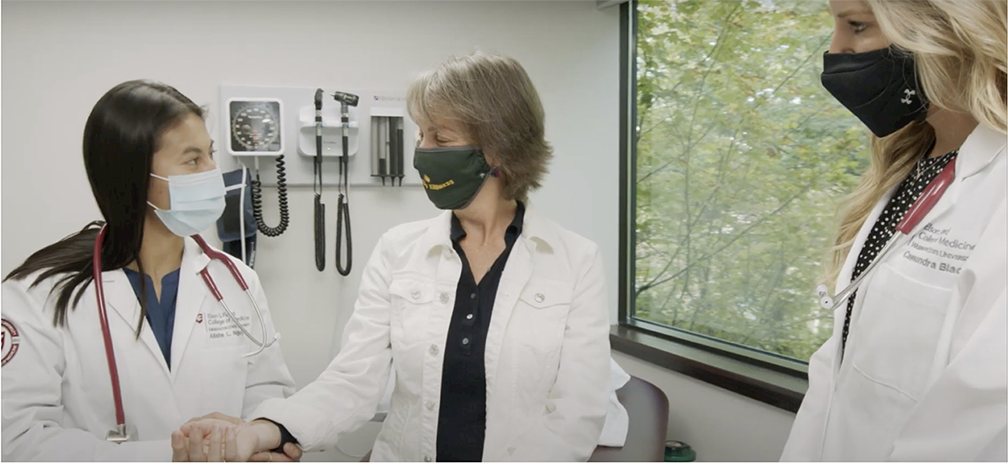
Every week, students work in pairs, with a standardized patient and a standardized preceptor, to complete a history and physical on one of that week’s CBL patients.
Practice that simulates clerkship learning:
-
- Students will practice asking for feedback (including WBAs)
- Students will practice clinical skills in front of others (learners, preceptors)
Clerk-level skills
Students will practice in small groups:
-
- Prioritize a differential diagnosis for a simulated encounter (EPA 2)
- Recommend common diagnostic and screening tests (EPA 3)
- Interpret common diagnostic and screening tests (EPA 3)
- Enter and discuss orders and prescriptions (EPA 4)
- Including calculating IV fluid rates for a pediatric patient
- Including calculating antibiotic dosing for a pediatric patient
- Document an assessment and plan in the EMR, demonstrating clinical reasoning
- Document SOAP notes for an obstetric patient
- Document a brief surgical operative note
Students will practice the following skills (formative assignments with self-assessment):
-
- Document a pediatric wellness visit (EPA 5)
- Prioritize a differential diagnosis following a clinical encounter (EPA 2)
- Document an adult hospital admission (EPA 5)
- Document an obstetric admission history and physical (EPA 5)
- Document a Subsequent Medicare Wellness visit (EPA 5)
Students will submit a summative assignment to be graded by faculty:
-
- Document an adult ambulatory chart note (EPA 5)
Every CBL patient will have an electronic medical record (EMR).
Students will practice:
-
- Tracking patient information in the electronic record
- Contributing to the electronic medical record
-
Practice
-
Assessment
-
EMR
Students will practice in small groups:
-
- Prioritize a differential diagnosis for a simulated encounter (EPA 2)
- Recommend common diagnostic and screening tests (EPA 3)
- Interpret common diagnostic and screening tests (EPA 3)
- Enter and discuss orders and prescriptions (EPA 4)
- Including calculating IV fluid rates for a pediatric patient
- Including calculating antibiotic dosing for a pediatric patient
- Document an assessment and plan in the EMR, demonstrating clinical reasoning
- Document SOAP notes for an obstetric patient
- Document a brief surgical operative note
Students will practice the following skills (formative assignments with self-assessment):
-
- Document a pediatric wellness visit (EPA 5)
- Prioritize a differential diagnosis following a clinical encounter (EPA 2)
- Document an adult hospital admission (EPA 5)
- Document an obstetric admission history and physical (EPA 5)
- Document a Subsequent Medicare Wellness visit (EPA 5)
Students will submit a summative assignment to be graded by faculty:
-
- Document an adult ambulatory chart note (EPA 5)
Every CBL patient will have an electronic medical record (EMR).
Students will practice:
-
- Tracking patient information in the electronic record
- Contributing to the electronic medical record
More Transition to Clerkship information

There is a variety of resources here—different ones will be relevant for different patients whom you encounter in Wesford.
Thank you for your contribution to the Transition to Clerkship!