




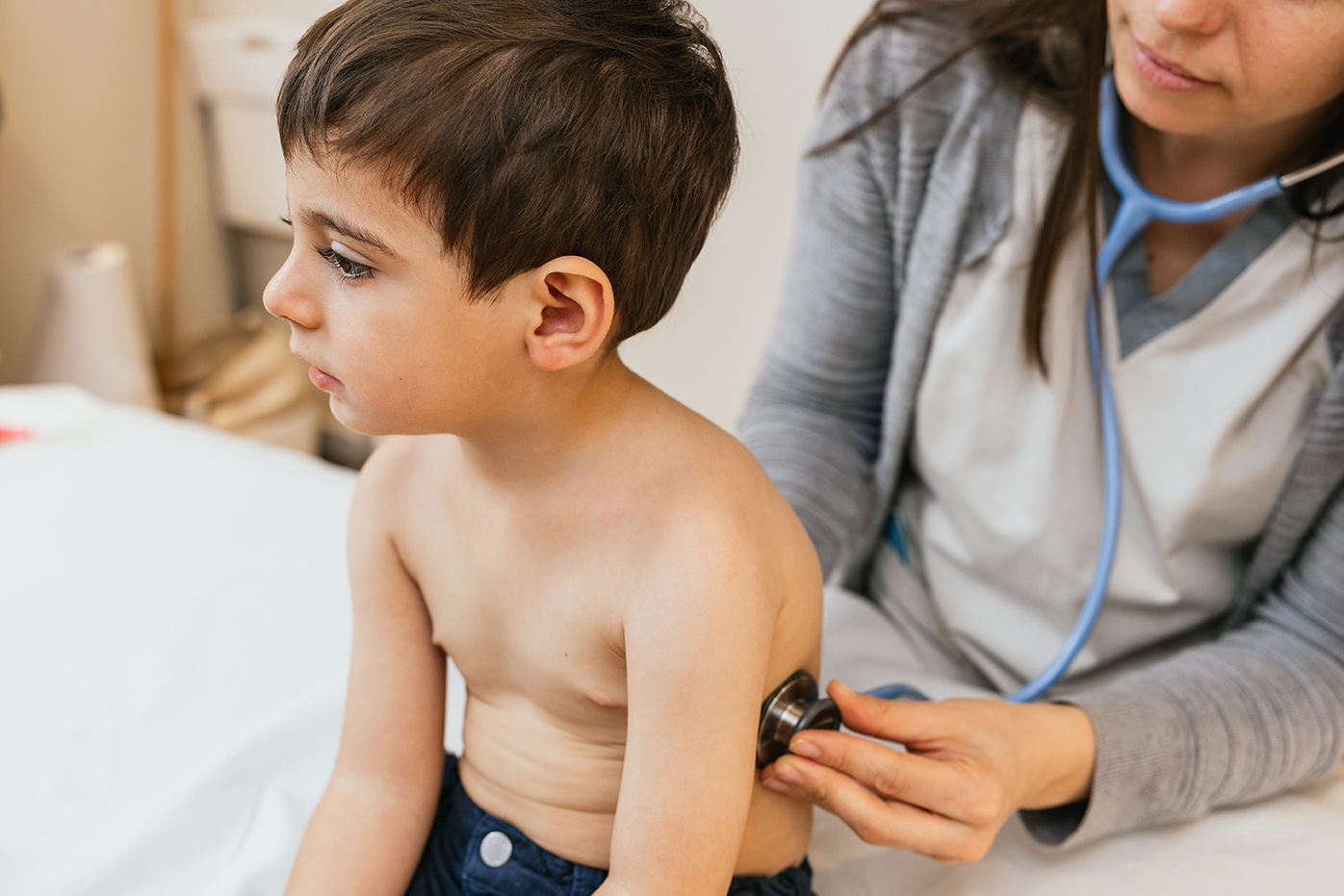
There are >100,000 hospitalizations of patients < 18 years old that can be attributed to community-acquired pneumonia (CAP). There is great variation in the care of these patients based on where they present (children’s hospital versus community hospital), with a common issue being over-utilization of antibiotics but also overuse of broad-spectrum antibiotics.
Note
This guideline is not for extrapolation to certain higher risk populations, including those ≤ 3 months of age, immunocompromised, tracheostomy-dependent, underlying chronic lung disease (cystic fibrosis, bronchopulmonary dysplasia, chronic lung disease), or those at risk for aspiration.
Epidemiology
Expected organisms vary based on age. In children under 5, the most common causes are viral pathogens; when there are bacterial causes the most common are strep pneumoniae, strep pyogenes, and staph aureus. In children 5 and older the more common organisms include Strep pneumoniae, Mycoplasma pneumoniae, Haemophilus influenzae (H. flu), and Moraxella catarrhalis.
Pathophysiology
Inflammation and edema of the small airways, compromise of the alveoli leading to collapse, and influx of immune cells leading to debris and fluid buildup are a few of the underlying physiologic mechanisms by which pneumonias are born.
Clinical features
Although there is no one specific clinical definition for CAP, many hospitals rely on the following constellation of symptoms: fever, tachypnea for age, hypoxia, work of breathing (retractions, belly breathing, nasal flaring), and focal findings on exam. Younger patients can also present with abdominal pain, nausea, and vomiting, due to systemic inflammation but also in cases of referred inflammation due to the proximity of the lower lung lobes and the stomach/small intestine.
Diagnosis
Community-acquired pneumonia is a clinical diagnosis that should be made based on clinical picture and lung exam findings.
- Chest x-rays are not routinely recommended for outpatient evaluation. They are higher yield in those with hypoxemia, severe respiratory distress, or those who have failed appropriate antibiotic therapy. Chest x-ray can show pneumothorax clearly; however, consolidation and effusion are difficult to fully interpret as it is an image of a single moment in time.
- Ultrasound has a higher sensitivity and specificity and can better evaluate consolidation versus atelectasis and quantify effusion.
- Blood cultures are not routinely recommended, however can be considered in those who are unvaccinated or presenting with sepsis physiology. Although blood cultures may seem like a “benign” test, they require a needle poke, and there is the risk of false positives (due to contamination) that can then prolong hospitalization and increase healthcare costs.
- Viral testing, such as short panel (COVID, Flu, RSV) and long panel (includes many viruses including Rhinovirus and Parainfluenza), may be useful in the decision to treat with antibiotics. Although co-infection with bacterial sources is possible, other testing (such as procalcitonin) can be used to risk stratify those patients.
- Procalcitonin is a biomarker that is more specific for bacterial infection than C-reactive protein (CRP) and is used to identify those children who are lower risk for having a bacterial etiology of their pneumonia. Procalcitonin has a higher sensitivity, meaning it is better at ruling out bacterial etiologies than it is at ruling in bacterial etiologies. A procalcitonin < 0.5ng/ml is supportive of a non-bacterial cause, and providers may use this in their decision making in conjunction with the clinical picture and other testing.
Management
- Supportive care with hydration, oxygen (nasal cannula or simple mask), pressure support (high flow or CPAP/BiPAP), and intubation.
- Recruitment efforts: incentive spirometers, flutter valves, chest physiotherapy, and cough assist. Early ambulation is high yield as well.
Antibiotic therapy
- For patients who are fully vaccinated for H. flu and Strep pneumoniae, first line therapy is amoxicillin/ampicillin.
- For patients who are not fully vaccinated, the consideration should be made to start with a third-generation cephalosporin such as ceftriaxone (inpatient) or cefuroxime/cefpodoxime (outpatient). Cefdinir can also be used outpatient, however it does leave a small gap in resistant Strep pneumoniae coverage when compared to the aforementioned cephalosporins.
- Those with complicated moderate or any severe pneumonia, including those with moderate to large effusions or any empyema, initial therapy should include ceftriaxone and initially coverage for methicillin-resistant Staph aureus (MRSA). These patients should have MRSA nasal swabs done. If negative, the MRSA specific coverage can be stopped. When possible, chest tube output should be sent for culture or PCR to better isolate an organism.
Mycoplasma pneumonia is usually characterized by prolonged duration of fever, cough, malaise, headache in children ≥ 5 years. Chest x-ray may show non-lobar, patchy, or interstitial pattern. If there is concern for atypical infection, specifically mycoplasma, then azithromycin can be started but testing specific to mycoplasma should be sent.
- There is no data to support use of IV antibiotics over oral antibiotics in the inpatient setting, however IV antibiotics are often used as a default or because patients are unable to tolerate PO.
- A 5-day course has been shown to be just as efficacious as longer courses, assuming continued patient improvement.
Potential complications
- Effusion: Data supports early chest tube placement leads to shorter lengths of stay for patients with large effusions, as the majority of these patients do not respond to antibiotics alone.
- Empyema: Will likely require general pediatric surgery consultation to consider thoracoscopic drainage, these patients do not respond to antibiotics alone.
- Pneumothorax.
- Cardiogenic shock due to tension physiology and decreased cardiac output.
Conclusion
Community-acquired pneumonia (CAP) is a common pediatric pathology, both inpatient and outpatient, and one of the areas in pediatrics where inappropriate antibiotic use is rampant. It is a clinical diagnosis, and imaging is not required or recommended unless there is concern for possible effusion or complication (pneumothorax). It is imperative that the provider look at age, local pathogen trends, and clinical picture when deciding on their treatment plan.
- John S. Bradley, Carrie L. Byington, Samir S. Shah, Brian Alverson, Edward R. Carter, Christopher Harrison, Sheldon L. Kaplan, Sharon E. Mace, George H. McCracken, Matthew R. Moore, Shawn D. St Peter, Jana A. Stockwell, Jack T. Swanson. The Management of Community-Acquired Pneumonia in Infants and Children Older Than 3 Months of Age: Clinical Practice Guidelines by the Pediatric Infectious Diseases Society and the Infectious Diseases Society of America. Clinical Infectious Diseases, Volume 53, Issue 7, 1 October 2011, Pages e25–e76.
- Laura F. Sartori, Yuwei Zhu, Carlos G. Grijalva, Krow Ampofo, Per Gesteland, Jakobi Johnson, Rendie McHenry, Donald H. Arnold, Andrew T. Pavia, Kathryn M. Edwards, Derek J. Williams. Pneumonia Severity in Children: Utility of Procalcitonin in Risk Stratification. Hosp Pediatr March 2021; 11 (3): 215–222.
- Mary Ann Queen, Angela L. Myers, Matthew Hall, Samir S. Shah, Derek J. Williams, Katherine A. Auger, Karen E. Jerardi, Angela M. Statile, Joel S. Tieder; Comparative Effectiveness of Empiric Antibiotics for Community-Acquired Pneumonia. Pediatrics January 2014; 133 (1): e23–e29. 10.1542/peds.2013-1773.
- McCulloh RJ, Koster MP, Yin DE, Milner TL, Ralston SL, Hill VL, Alverson BK, Biondi EA. Evaluating the use of blood cultures in the management of children hospitalized for community-acquired pneumonia. PLoS One. 2015 Feb 6;10(2):e0117462.
- Pernica JM, Harman S, Kam AJ, et al. Short-Course Antimicrobial Therapy for Pediatric Community-Acquired Pneumonia: The SAFER Randomized Clinical Trial. JAMA Pediatr. 2021;175(5):475–482.
- Pereda MA, Chavez MA, Hooper-Miele CC, Gilman RH, Steinhoff MC, Ellington LE, Gross M, Price C, Tielsch JM, Checkley W. Lung ultrasound for the diagnosis of pneumonia in children: a meta-analysis. Pediatrics. 2015 Apr;135(4):714–22.
- Ross E. Newman, Erin B. Hedican, Joshua C. Herigon, David D. Williams, Arthur R. Williams, Jason G. Newland. Impact of a Guideline on Management of Children Hospitalized With Community-Acquired Pneumonia. Pediatrics March 2012; 129 (3): e597–e604. 10.1542/peds.2011–1533.
- Same RG, Amoah J, Hsu AJ, Hersh AL, Sklansky DJ, Cosgrove SE, Tamma PD. The Association of Antibiotic Duration With Successful Treatment of Community-Acquired Pneumonia in Children. J Pediatric Infect Dis Soc. 2021 Apr 3;10(3):267–273.
- Williams DJ, Creech CB, Walter EB, et al. Short- vs. Standard-Course Outpatient Antibiotic Therapy for Community-Acquired Pneumonia in Children: The SCOUT-CAP Randomized Clinical Trial. JAMA Pediatr. 2022;176(3):253–261.
- Williams DJ, Edwards KM, Self WH, Zhu Y, Arnold SR, McCullers JA, Ampofo K, Pavia AT, Anderson EJ, Hicks LA, Bramley AM, Jain S, Grijalva CG. Effectiveness of β-Lactam Monotherapy vs. Macrolide Combination Therapy for Children Hospitalized With Pneumonia. JAMA Pediatr. 2017 Dec 1;171(12):1184–1191.
Image credits
Unless otherwise noted, images are from Adobe Stock.