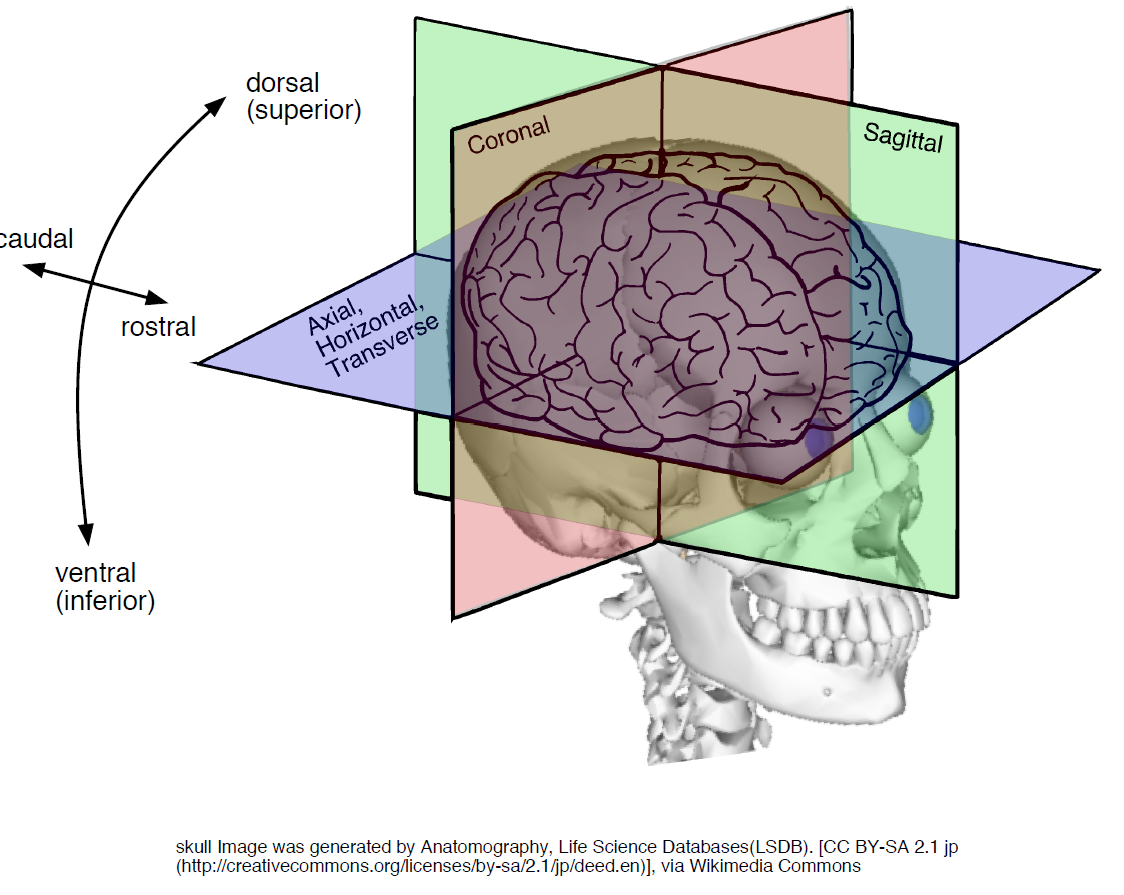
Recall that the surfaces of the cerebrum, and therefore the lobes, have a distinct topography that is formed by the sulci and gyri.
Sulcus (pl. sulci)
A groove or furrow (L.)
Gyrus (pl. gyri )
A ridge or convolution (L.)
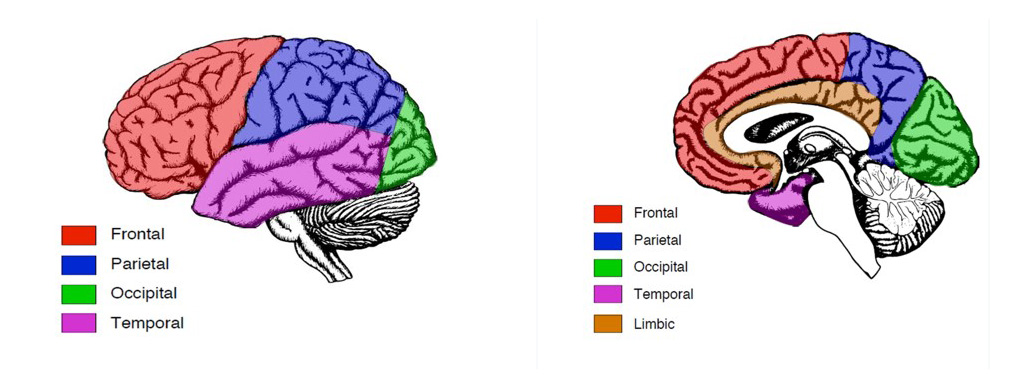
Identify frontal, parietal, occipital, and temporal lobes of the cerebrum on a brain.
Frontal lobe
Parietal lobe
Occipital lobe
Temporal lobe
Lobes of the cerebral hemisphere. WSU_CVM_NEUROANATOMY IMAGE.
The limbic (limbus=margin or border L.) lobe is sometimes included as a functional lobe, but is in fact comprised of the medial portions of the frontal, parietal, and temporal lobes.
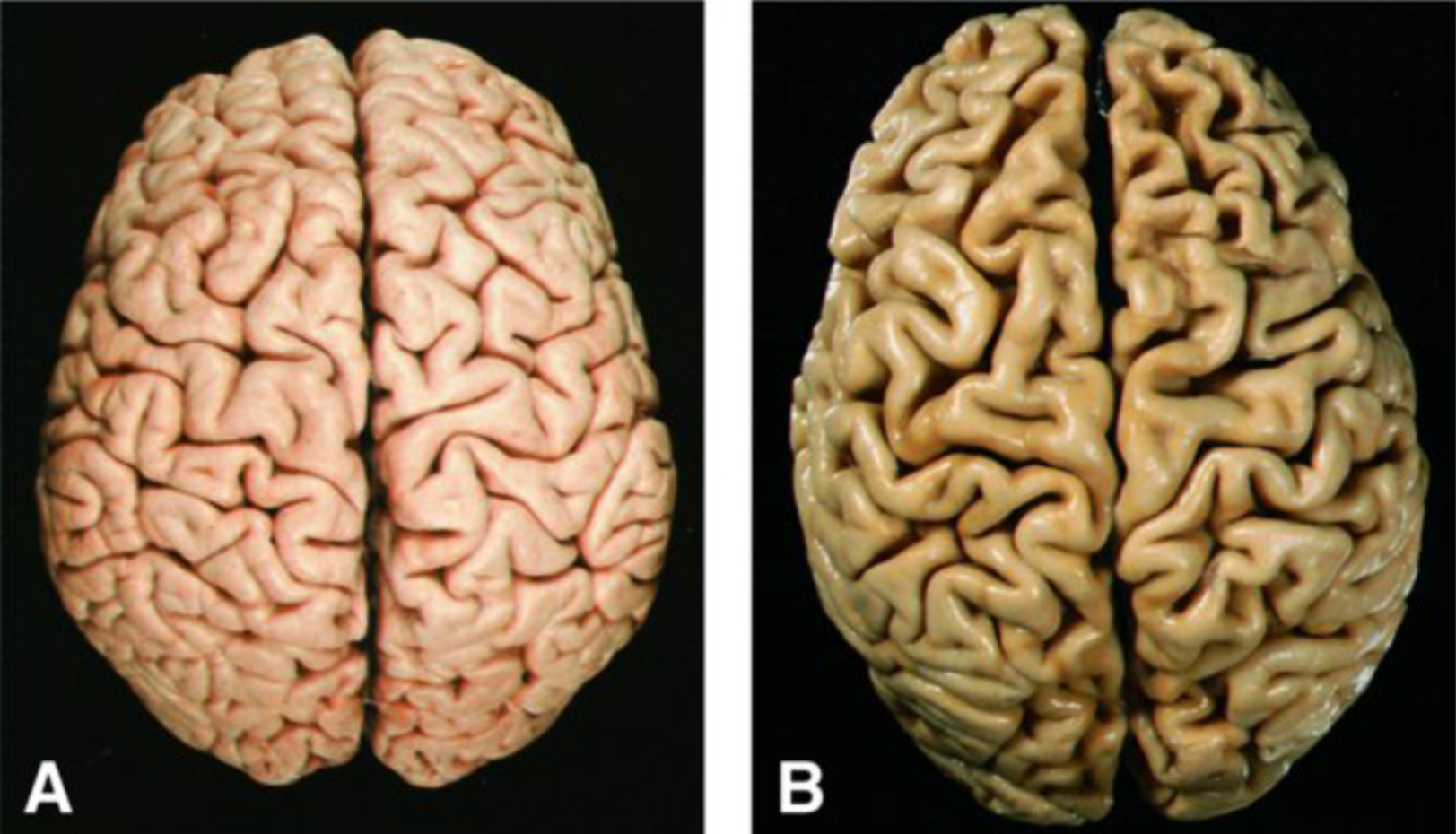
There is a loss of cortical tissue leading to narrowing of the gyri, widening of the sulci, or both in old age and disease processes. See Figure 3. The brain in panel A is from a normal patient, and the brain in panel B is from an older patient experiencing a loss of cortical tissue.
Thought question
List some common neurologic disorders that could lead to a loss of cortical tissue, as seen in Figure 3B.
Figure 3. From Chapter 32: The Central Nervous System, Rubin’s Pathology: Clinicopathologic Foundations of Medicine, 7e; Strayer et al. 2014; Wolters and Kluwer.
The cerebral cortex controls or receives information from the contralateral side of the body (Valsalva Doctrine). Therefore, unilateral cerebral lesions produce signs and symptoms on the opposite side of the body.
Clinical correlation
All the regions of the cortex perform different and diverse functions. Understanding the localization and nature of focal injuries to the cortex as it relates to specific clinical symptoms is an extremely important role of any clinician.
Sulci/fissures of the cerebrum
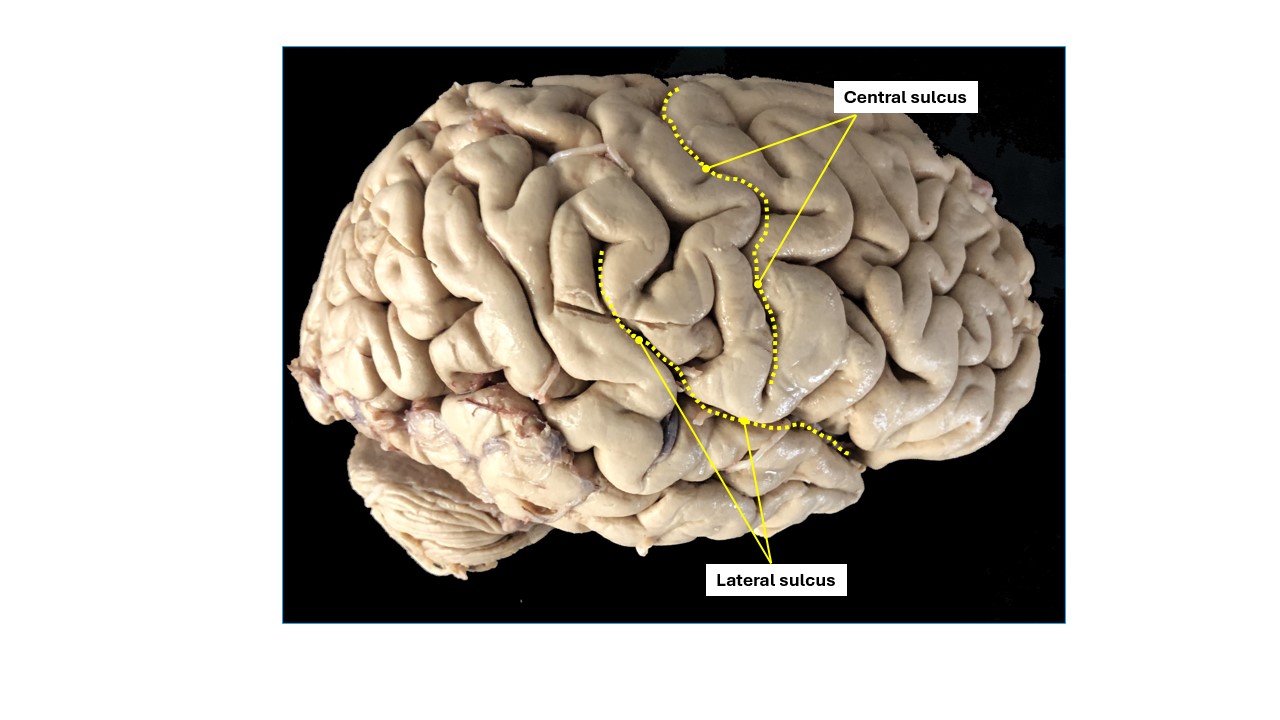
Identify the sulci/fissures of the cerebrum on a brain.
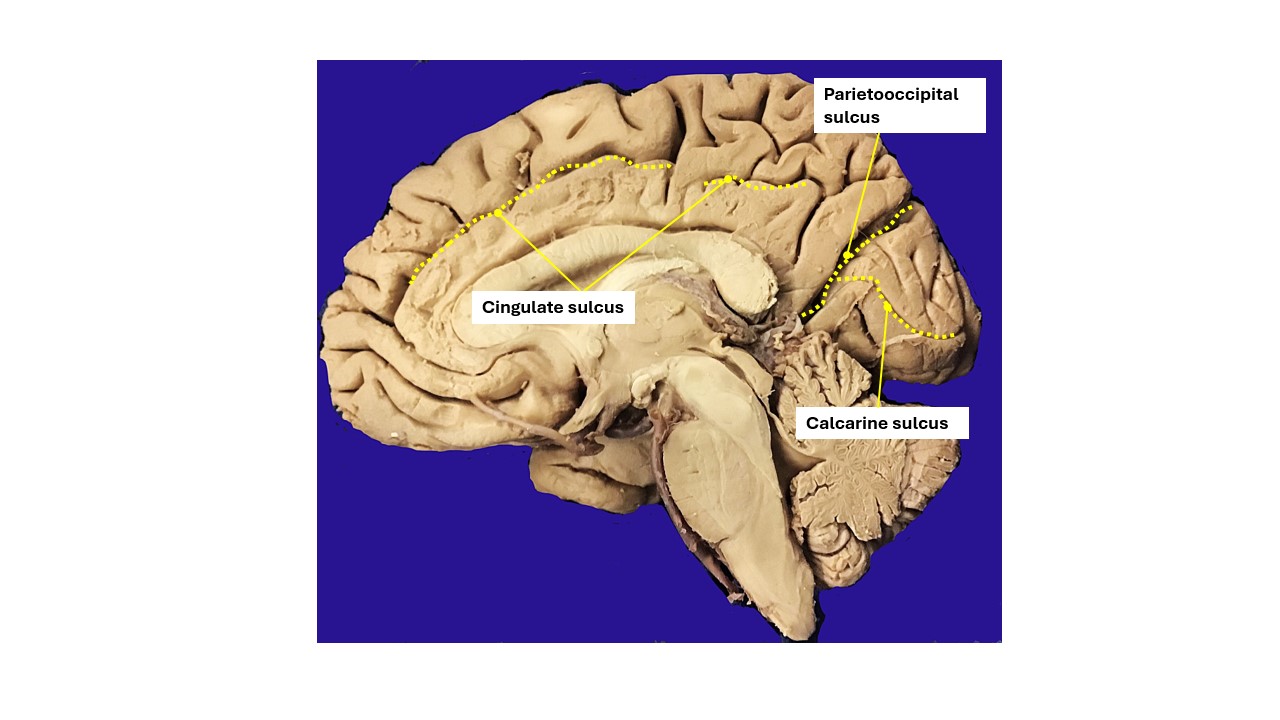
Figure 1.
Figure 2.
Longitudinal, a.k.a. sagittal fissure/sulcus: Separating the two cerebral hemispheres
Lateral sulcus (Sylvian fissure): Separating temporal lobe from parietal and frontal lobe
Parieto-occipital sulcus: Separating the parietal and occipital lobes (seen medially)
Central sulcus: Separating the frontal and parietal lobes
Cingulate sulcus: Dorsal (superior) to the cingulate gyrus
Calcarine sulcus—on medial surface of occipital lobe: Superior and inferior temporal sulci
Major gyri of cerebral lobes
Identify the major gyri of the cerebral lobes on a brain.
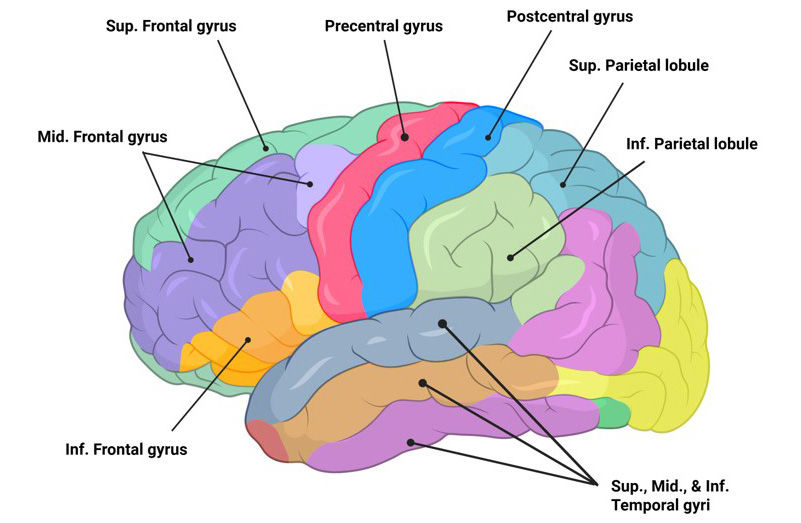
Figure 3.CREATED WITH BIORENDER.COM.
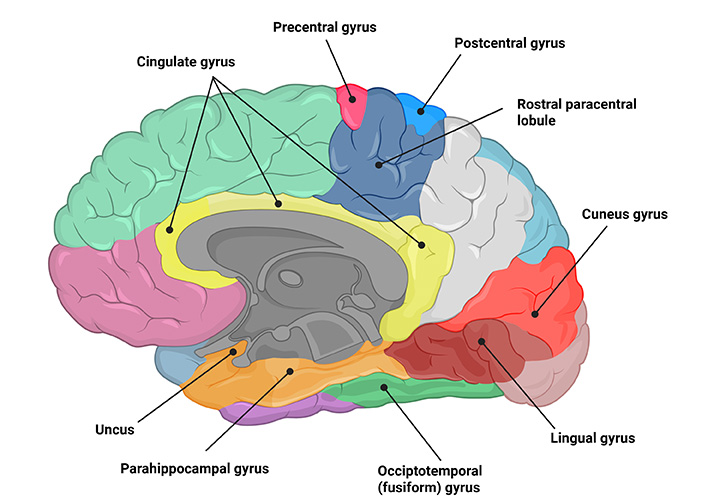
Figure 4.CREATED WITH BIORENDER.COM.
Frontal lobe
Precentral gyrus
Superior, middle and inferior frontal gyri
Cingulate gyrus (superior to the corpus callosum)
Parietal lobe
Postcentral gyrus
Superior parietal lobule
Inferior parietal lobule (supramarginal and angular gryi are parts of inferior parietal lobule)
Occipital lobe
Lingual gyrus (inferior to the calcarine sulcus)
Cuneus (posterior to the parieto-occipital sulcus and superior to the calcarine sulcus)
Temporal lobe
Superior, middle and inferior temporal gyri
Occipito-temporal (fusiform) gyrus
Parahippocampal gyrus: Part of the medial temporal lobe
Uncus: Part of the medial temporal lobe
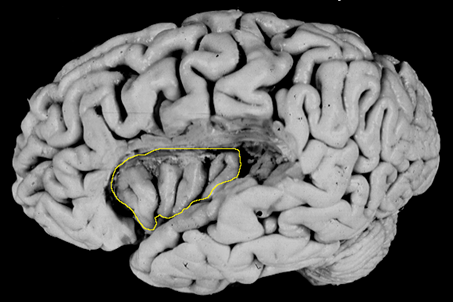
Insula: Deep in the lateral fissure; composed of multiple gyri
Figure 5. Left cerebral hemisphere dissected to expose insula. Specimen from Neuroanatomy Collection, Washington State University College of Veterinary Medicine. The insula is outlined in yellow on the above image. (Note: inferior portions of the frontal and parietal lobes have been removed.) The insular cortex has many functions, such as emotions, motor control, and homeostasis.
Clinical correlation
From the perspective of a clinican, the anatomy of brain and spinal cord are thought of in terms of how they appear in sections or slices that are obtained by either CT or MRI imaging techniques.
Coronal sections provide an excellent way of visualizing the anatomy of cerebrum. Topographic features that can be visualized include the depth of the sulci, differences in the gray and white matter, and the parts of the ventricular system. Pathologic changes to neuronal tissue and the extent of masses can be noted using these planes of section.
interactive
What are each of these colored parts?
The coronal section is through the mid-thalamus and anterior portion of the midbrain and pons. Specimen from Neuroanatomy Collection, Washington State University College of Veterinary Medicine. (Tap the right arrow for labels)
Portions of the medial temporal lobe outlined in green and light blue is an area where degeneration of cortical tissue occurs during Alzheimer’s disease (discussed in the limbic system lecture in FMS 512 using case examples and providing clinical contexts).
Axonal fiber bundles of the cerebrum
Identify the axonal fiber bundles of the cerebrum on a mid-sagittal brain.
Fiber bundles are classified as commissural, association, projection fibers.
Locate the following axonal fiber bundles in the cerebrum, which can serve as good landmarks.
Corpus callosum: A large bundle of commissural fibers located inferior to the cingulate gyrus
Consists of a rostrum, genu, body, and splenium
Anterior commissure: A small bundle of commissural fibers that connects inferior portions of the temporal lobes
Fornix: Association fibers which provide the major connection between the hippocampus and hypothalamus/thalamus. (This is a very important fiber tract in learning and memory and is discussed during the Limbic System lecture.)
Interactive
Which fiber bundles of cerebrum are each of these labeled parts?
Specimen from Neuroanatomy Collection, Washington State University College of Veterinary Medicine. (Tap the right arrow for labels)