




- Suggested reading
- Reading guide
- Need to Know
There is one chapter for suggested reading from Lippincott: Chapter 16: Fatty Acid, Triacylglycerol, and Ketone Body Metabolism. The short descriptions and videos listed below are some of the big-picture, high-yield points. The reading and the class session will go into more depth and detail. The reading guides are also posted.
As I have said in other modules, this reading guide is for people who have difficulty focusing on these types of chapters. Most students DO NOT need to use the guide.
Fatty acid and triacylglycerol metabolism are covered in Chapter 16.
Fatty acid structure
-
What is the basic structure of a fatty acid? Why are FA amphipathic in nature?
-
What is meant by the term “saturated” in regards to fatty acids? What about “unsaturated” fatty acids? (Fig. 16.3)
-
What are the essential fatty acids? Which fatty acid is a precursor for prostaglandins?
-
Be familiar with the common names of fatty acids and understand the naming system that is utilized. (Fig. 16.4)
Fatty acid synthesis
-
Where does fatty acid synthesis primarily take place? Are there other places it can occur?
-
Why is acetyl coenzyme A important? How is it produced? Why is cytosolic citrate viewed as a “high-energy” signal? (Fig. 16.7)
-
What is malonyl CoA? What enzyme is important for malonyl CoA production? Is there a coenzyme involved, if so, what is it? (Fig. 16.7)
-
Explain short term regulation and long-term regulation of acetyl CoA carboxylase. When is each used? Why? (Fig. 16.8)
-
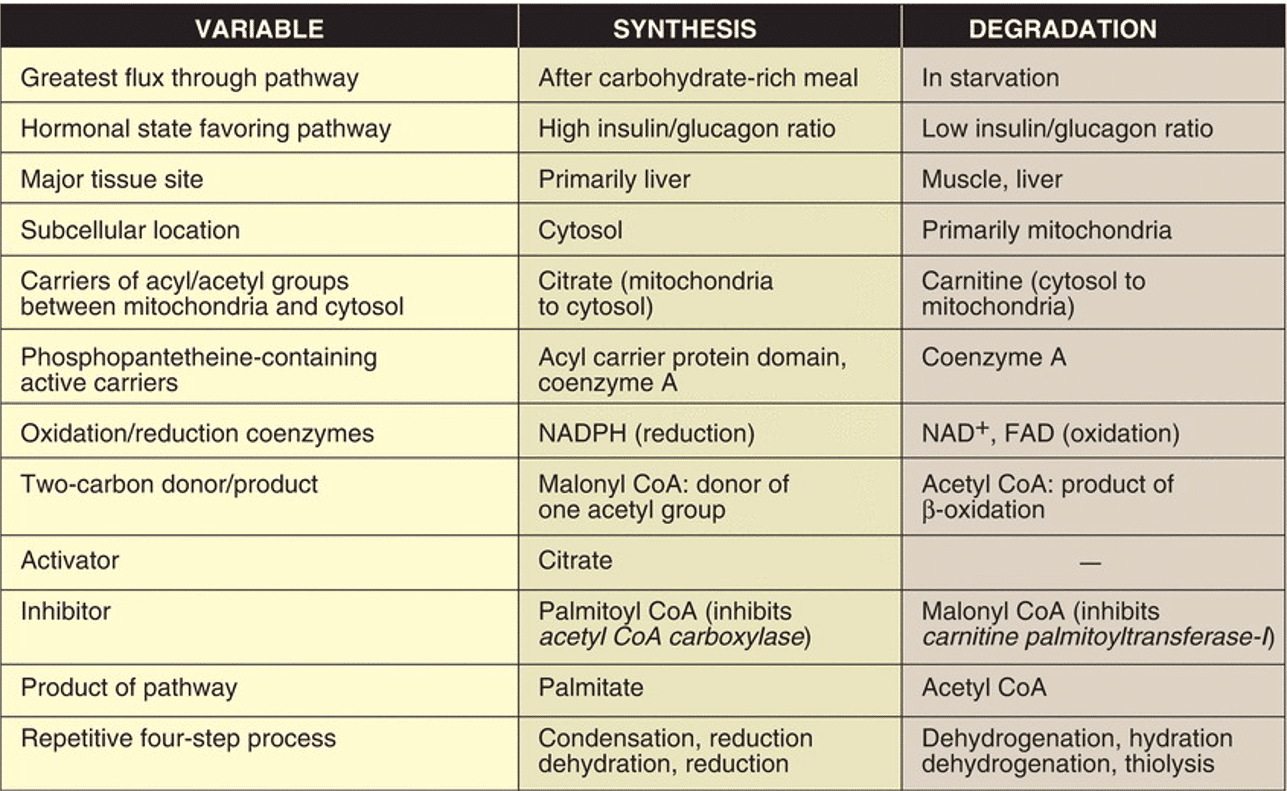
What is fatty acid synthase? Why is it important? How does it relate to palmitate? Be able to describe/understand how the enzyme works. Why is malonyl CoA important to Fatty Acid synthase? Where does NADPH come from for fatty acid synthesis? (Fig. 16.9 and 16.11)
-
How are fatty acids elongated beyond 16 carbon structures?
-
What is a “desaturase”? How and where does it perform its function? Why is glycerol phosphate important? (Fig. 16.14)
Mobilization of stored fats and oxidation of fatty acids
-
How are fatty acids stored? What is a triacylglycerol (TAG)? How are TAGs stored? What is the fate of TAGs in the liver? And in adipose tissue? (Fig. 16.15)
-
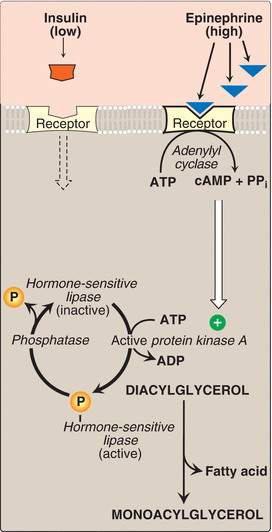
How are fatty acids released from TAG? What controls this release? How is this activated? What happens to glycerol? What is the fate of the free fatty acids? (Fig. 16.15)
-
What is beta-oxidation? Why is it important? How does the transport of long-chain fatty acids into the mitochondria occur? What is the carnitine shuttle? How is it controlled? Where does carnitine come from? What happens when carnitine is deficient? How does this occur? (Fig. 16.16)
-
What are the basic reactions of beta-oxidation? What is the energy yield of beta-oxidation? (Fig. 16.17 and 16.18)
-
What is MCAD deficiency?
-
How does beta-oxidation of fatty acids with odd numbers occur? What are the CoAs involved with this process? (Fig. 16.17)
-
Beta-oxidation can take place in a peroxisome. Why? How is it different?
-
What is alpha-oxidation?
Ketone bodies
-
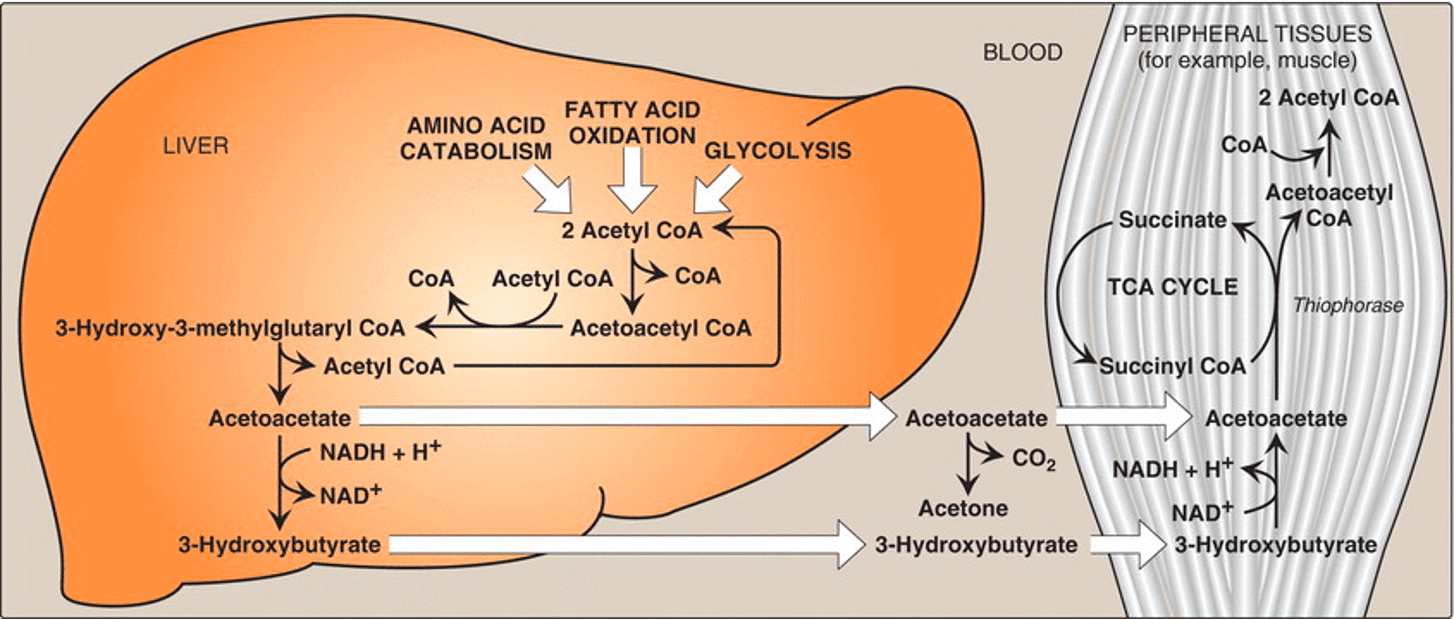
What are ketone bodies? What is, and explain ketogenesis? (Fig. 16.22) How does it occur? What is ketosis? What happens to ketone bodies in diabetes mellitus? (Fig. 16.24)
Describe the structure of fatty acids and how fatty acids are synthesized, stored, and utilized
-
Acetyl CoA Carboxylase (ACC)
-
Glycerol Kinase
-
Glycerol-Phosphate-dehydrogenase
-
Fatty Acid Synthase
-
Malic enzyme
-
Relationship between glucose metabolism and FA synthesis
-
Nomenclature and how to name fatty acids
-
TAG synthesis
Describe fatty acid liberation from adipose and its importance in energy homeostasis
-
Diseases
-
Hormone sensitive lipase
-
Adipose Triglyceride Lipase
Describe fatty acid oxidation and ketone body production and explain their importance in energy homeostasis
-
b-oxidation
-
Carnitine Shuttle
-
carnitine palmitoyl-transferase I (CPTI)
-
carnitine palmitoyl-transferase II (CPTII)
-
HMG CoA Synthase
-
Carnitine
-
Ketone body synthesis
Describe the inborn errors of metabolism which result in fatty acid oxidation disorders
-
Carnitine deficiencies
-
CPT-I deficiencies
-
CPT-II deficiencies
-
Medium-chain fatty acyl CoA dehydrogenase deficiency (MCAD)
-
Refsum disease
Describe the structure of fatty acids and how fatty acids are synthesized, stored, and utilized
This is a high-yield topic; therefore Osmosis has a video on it.
Describe fatty acid liberation from adipose and its importance in energy homeostasis
This video is for the next two learning goals, and another Osmosis video covers it.
Describe fatty acid oxidation and ketone body production and explain their importance in energy homeostasis
Describe the inborn errors of metabolism which result in fatty acid oxidation disorders
| Disease | Description |
|---|---|
|
MCAD deficiency |
Lack of medium-chain acyl-CoA dehydrogenase activity, leading to hypoglycemia and reduced ketone body formation under fasting conditions. |
|
Carnitine deficiency |
A primary carnitine deficiency is the lack of a membrane transporter for carnitine; a secondary carnitine deficiency is the result of other metabolic disorders.
|
|
Zellweger Syndrome |
A defect in peroxisome biogenesis, leading to a lack of peroxisomes and the inability to synthesize plasmalogens or oxidize very-long-chain fatty acids.
|
|
CPT-I deficiency
|
Affects the liver, where an inability to use LCFA for fuel greatly impairs that tissue’s ability to synthesize glucose (an endergonic process) during a fast. This can lead to severe hypoglycemia, coma, and death. |
|
CPT-II deficiency
|
Affect the liver and cardiac and skeletal muscle. The most common (and least severe) form affects skeletal muscle. It presents as muscle weakness with myoglobinemia following prolonged exercise. Treatment includes avoidance of fasting and adopting a diet high in carbohydrates and low in fat but supplemented with medium-chain TAG.
|
question
Out of the following choices, what is the best name for this structure (Alpha-linolenic acid)?
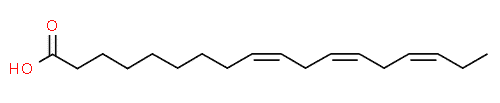
The carbon atoms are numbered, beginning with the carbonyl carbon as carbon 1. The number before the colon indicates the number of carbons in the chain, and those after the colon indicate the numbers and positions (relative to the carboxyl end) of double bonds.
For example, as denoted this question, alpha-linolenic acid, 18:3(9,12,15), is 18 carbons long and has four double bonds (between carbons 9–10, 12–13, and 15–16). The double bonds in a fatty acid can also be referenced relative to the w (methyl) end of the chain. Alpha-linolenic acid is referred to as an ω-3 fatty acid because the terminal double bond is three bonds from the ω end.
question
The carnitine shuttle is an important component of fatty acid beta-oxidation. It utilizes carnitine palmitoyl-transferase I and II (CPT1 and CPTII) to shuttle fatty acyl-CoA into the mitochondria.
question
A prisoner goes on a hunger strike to protest the conditions of his detainment. After several days, his blood glucose level is significantly reduced. In order to keep a constant supply of energy to his brain and muscle, which of the following molecules is his liver releasing into the bloodstream?
The liver’s role during starvation is to release both glucose (via gluconeogenesis) and ketone bodies into the blood. Adipose tissue provides fatty acids both for muscle and liver. Muscle oxidizes the fatty acids completely to CO2 and water for energy. The liver converts about half of the fatty acids it takes up into ketone bodies (acetoacetate and beta-hydroxybutyrate), which it releases into the blood. The other half is oxidized to provide energy for the liver. Glycogen reserves are gone after 30 hours, but even when present, glycogen is never released into the blood as a polymer. It is broken down to G1P, which is then converted to G6P, which is then hydrolyzed to free glucose. Only free glucose can exit the cell.