




- Suggested reading
- Reading guide
- Need to Know
- Osmosis videos
There is one chapter for suggested reading from Lippincott. Chapter 15 is on Dietary Lipid metabolism. The short descriptions and videos listed below are some of the big-picture, high-yield points. The reading and the class session will go into more depth and detail. The reading guides are also posted.
As I have said in other modules, this reading guide is for people who have difficulty focusing on these types of chapters. Most students DO NOT need to use the guide.
Metabolism of Dietary Lipids is covered in Chapter 15
-
Be able to recognize the following: fatty acid, triacylglycerol, phospholipid, steroid, glycolipid (Fig. 15.1)
Processing of dietary lipid in the stomach
-
How does the processing of dietary lipid take place in the stomach? What are the important enzymes for this process, and where does their action take place? (Fig. 15.2)
-
Patients with cystic fibrosis have a defective gene that affects pancreatic enzymes. Why does this occur?
Emulsification of dietary lipid
-
What is the process of emulsification? Where does it take place?
-
What are bile salts? Why are they important? (Fig. 15.3)
Degradation of dietary lipids
-
How is TAG degraded? Where are they degraded? What enzymes are important for this degradation? What is the mechanism? What happens if you inhibit these enzymes?
-
How are cholesteryl esters degraded? What is the product of this degradation?
-
How are phospholipids degraded?
-
What are the hormones that control lipid digestion? Where do they originate from and how do they work? (Fig. 15.4)
Absorption of lipids
-
What is meant by the term “mixed micelle”? Why are mixed micelles important? (Fig. 15.5)
-
Where does the absorption of lipids occur? How does this happen? (Fig. 15.6)
-
What is a chylomicron?
-
Where are TAGs and cholesteryl esters resynthesized? How does this occur? Where does it occur?
Lipid malabsorption
-
What does the term “steatorrhea” mean? Why does it occur? (Fig. 15.7)
Secretion of lipids
-
How are lipids secreted from enterocytes? What is apolipoprotein B-48?
Dietary lipid utilization
-
Where are TAGs utilized? What is the fate of the free fatty acids and glycerol from the breakdown of TAGs?
-
What are Type I and Type III hyperlipoproteinemia?
Explain the enzymatic synthesis of triacylglycerols and cholesteryl esters in enterocytes and their role in lipid absorption and transport
-
Chylomicrons
-
Absorption and re-synthesis of lipids
-
acyltransferases
-
acyl CoA:cholesterol acyltransferase
Describe how tissues utilize dietary lipids
-
Lipoprotein lipase
-
Apolipoprotein B-48
Describe how dietary lipids are processed and absorbed
-
Emulsification
-
Cholecystokinin (CCK)
-
Secretin
-
Orlistat
-
Mixed micelles
-
Lingual lipase
-
Gastric lipase
-
Pancreatic lipase
-
Colipase
-
Phospholipase A2
-
Cystic Fibrosis
-
Steatorrhea
-
Bile Salts
Disease states
-
Type I hyperlipoproteinemia
-
Type III hyperlipoproteinemia
-
Cystic fibrosis (as related to lipid metabolism)
There are two Osmosis videos that are relevant, in a tangential way, to this session. These are good for all the lipid sessions and are full of great material to know:
High-yield: Lipid disorders
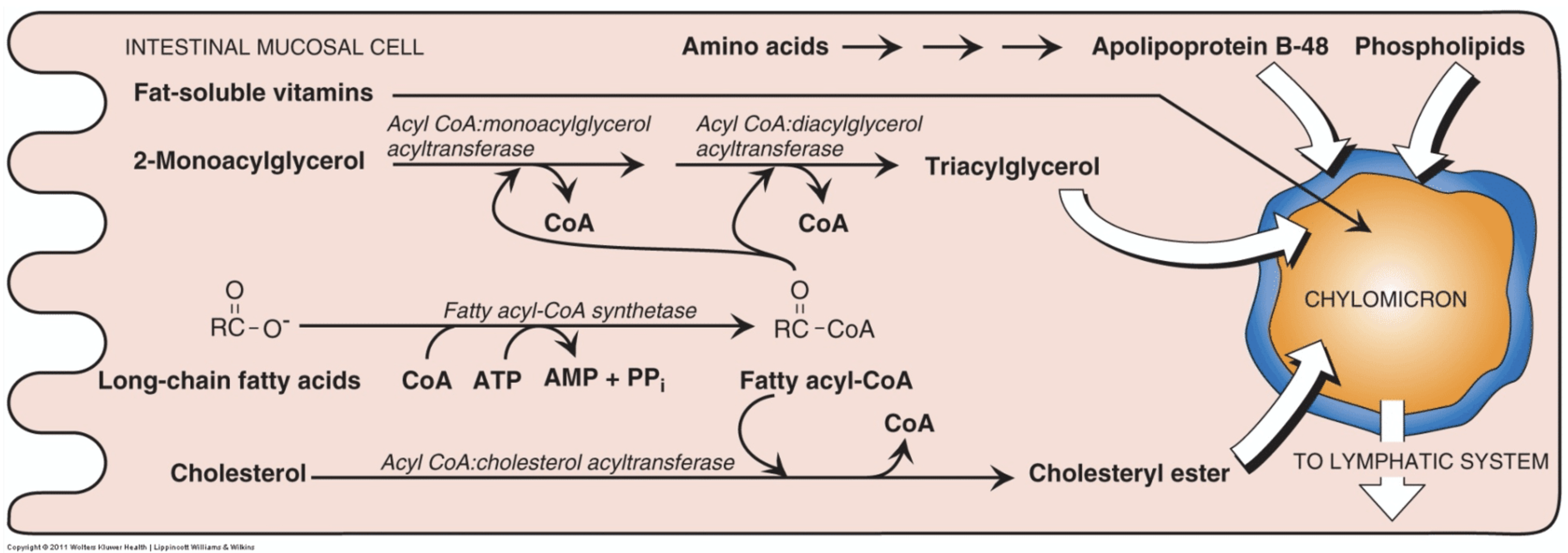
Explain the enzymatic synthesis of triacylglycerols and cholesteryl esters in enterocytes and their role in lipid absorption and transport
The take-home point here: everything that comes into the gut needs to be taken apart by lipases and resynthesized in the enterocyte. The enterocyte has many different specialized acyltransferases to do this. Everything then gets packed into a chylomicron and sent out into the lymph.
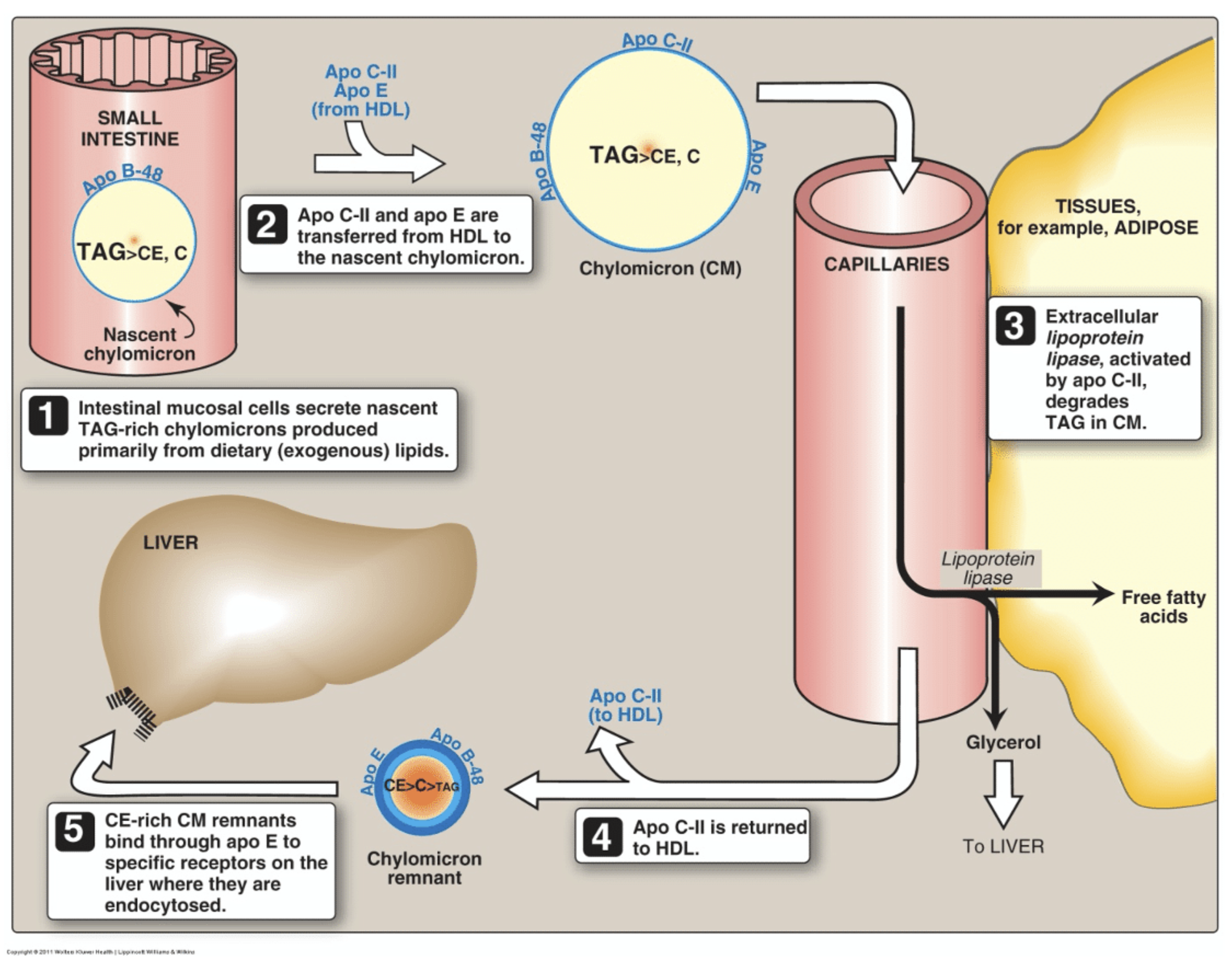
Describe how dietary lipids are utilized by tissues
Chylomicron metabolism
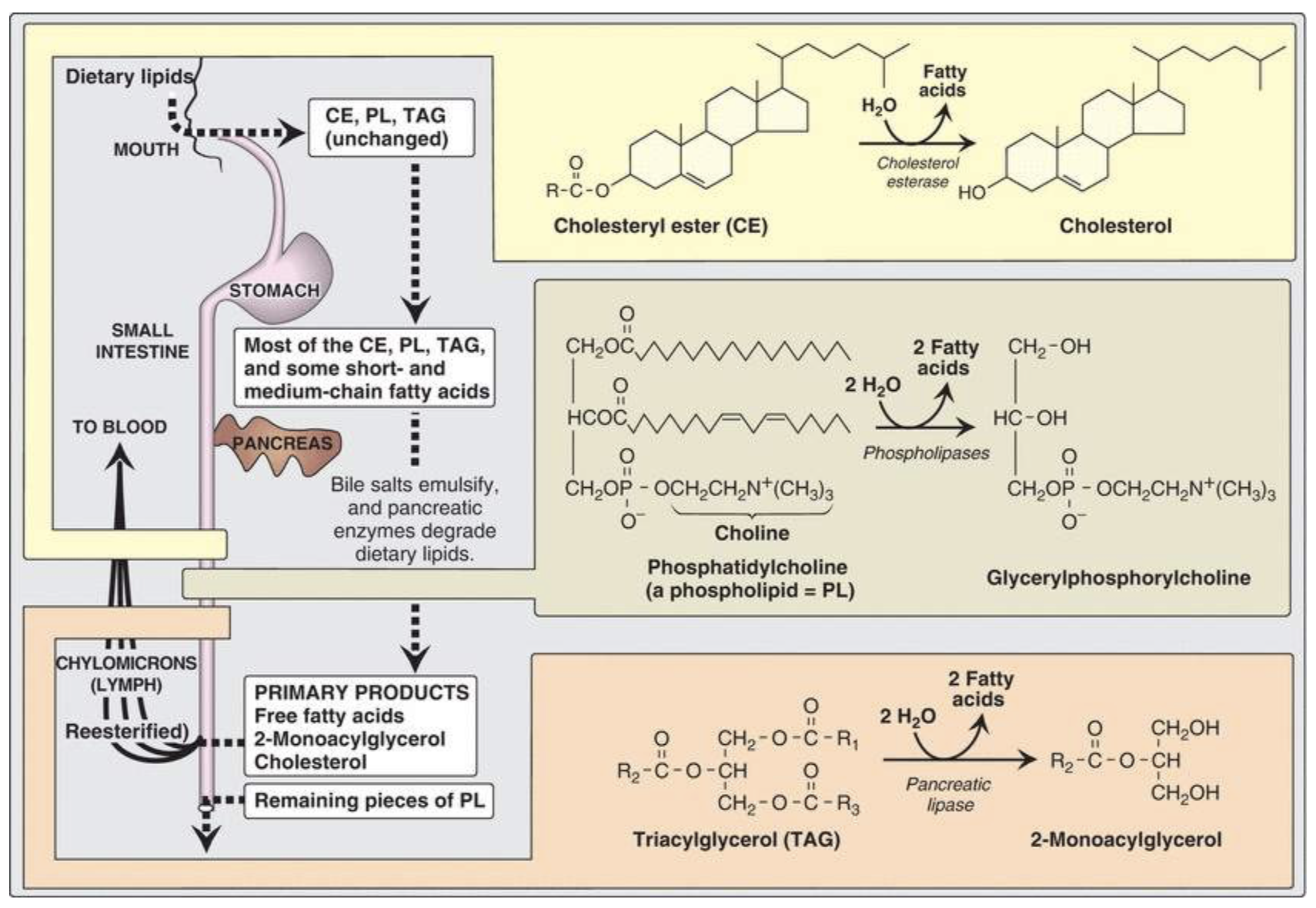
Describe how dietary lipids are processed and absorbed
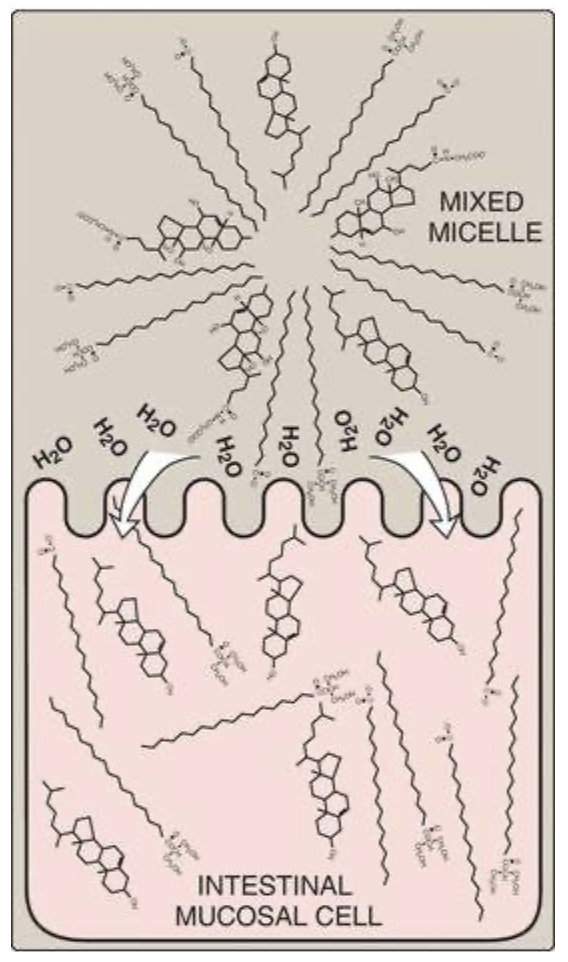
The Osmosis video posted earlier in this module gets into this a little bit. The use of lipases, phospholipase, and cholesterol esterases are essential to remove fatty acids from TAGs, phospholipids, and esterified cholesterol. Fatty acids must be broken down first, and then a mixed micelle forms to move into the enterocyte.
question
Emulsification of lipids is important to increase the surface area of the lipid droplet. Which of the following substances is made in the liver and aids in this emulsification?
Dietary lipid emulsification occurs in the duodenum. Emulsification increases the surface area of the hydrophobic lipid droplets so that the digestive enzymes, which work at the interface of the droplet and the surrounding aqueous solution, can act effectively. Emulsification is accomplished by two complementary mechanisms, namely, use of the detergent properties of the conjugated bile salts and mechanical mixing due to peristalsis.
question
As lipids are digested in the gastrointestinal tract, they are absorbed by enterocytes. Which of the following occurs in an enterocyte during dietary lipid metabolism?
A mixture of lipids absorbed by the enterocytes migrates to the smooth endoplasmic reticulum (SER) where biosynthesis of complex lipids takes place. The long-chain FA are first converted into their activated form by fatty acyl coenzyme A (CoA) synthetase (thiokinase). Using the fatty acyl CoA derivatives, the 2-MAG absorbed by the enterocytes are converted to TAG through sequential reacylations by two acyltransferases, acyl CoA:monoacylglycerol acyltransferase and acyl CoA:diacylglycerol acyltransferase. Lysophospholipids are reacylated to form phospholipids by a family of acyltransferases, and cholesterol is acylated primarily by acyl CoA:cholesterol acyltransferase.
[Note: Virtually all long-chain FA entering the enterocytes are used in this fashion to form TAG, phospholipids, and cholesteryl esters. Short- and medium-chain FA are not converted to their CoA derivatives and are not reesterified to 2-MAG. Instead, they are released into the portal circulation, where they are carried by serum albumin to the liver.]