



Learning goals
- Describe the epidemiology and risk factors for meningitis and list the primary pathogens that lead to meningitis, based on age groups
- Compare and contrast the clinical manifestations of encephalitis, acute bacterial meningitis, aseptic meningitis, and chronic meningitis and use cerebrospinal fluid findings to differentiate various microbial etiologies
- Describe the microbiologic features (classification, structures, pathogenicity, and laboratory identification) of Neisseria meningitidis
- Recommend an appropriate empiric antibiotic regimen for bacterial meningitis, based on age
- State key prevention strategies for common types of bacterial meningitis
Abstract
Among the syndromes in Infectious Diseases, CNS infections may have one of the more broad microbiologic differentials—there are many pathogens that can infect and/or affect the CNS. There are certain organisms that do this more commonly than others. This session aims to orient students to the clinical syndromes in CNS infections, the most commonly associated pathogens, the uncommon but important pathogens, and the ways we treat CNS infections.
The large group time will use case studies for clinical application. PLEASE come prepared to work through cases by watching the pre-class assigned videos.
Required pre-class materials
Click the blue icons below to go to the resources listed.
Recommended study materials
These materials are not required; they are supplementary to the large-group session. They are intended as a curated guide to content focused on the learning objectives. There are both textbook and video resources for this session for students to use per their preference.
For each reference, I have designated the learning goal addressed with a learning goal icon and and number.
Click the blue icons below to go to the resources listed.
-
Levinson Review of Medical Microbiology & Immunology: A Guide to Clinical Infectious Diseases, 17e
Chapter 72: Central Nervous System Infections
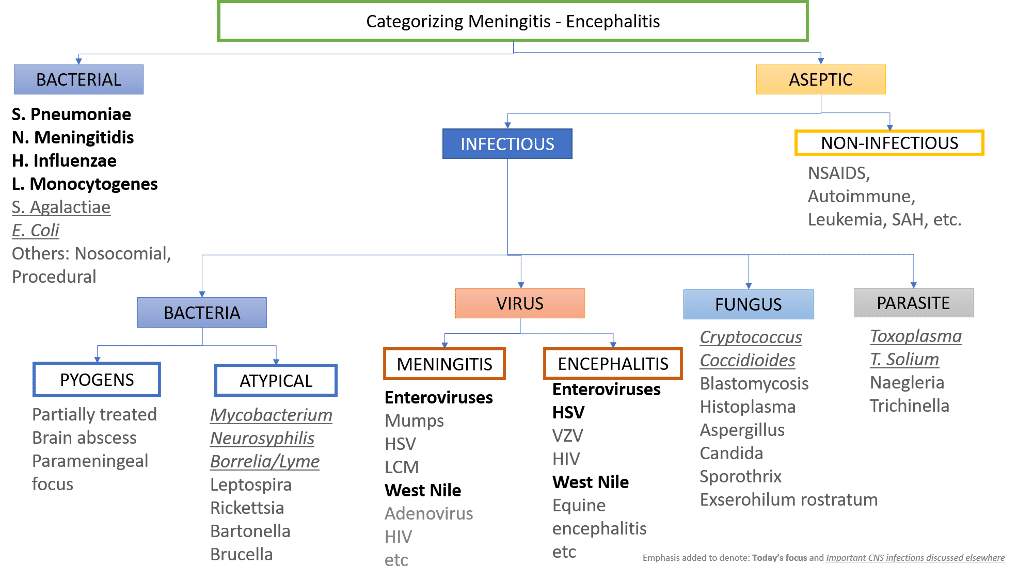
Sections on Meningitis and Encephalitis: While reading, use this categorization scheme to help you differentiate the clinical entities.
-
Levinson Review of Medical Microbiology & Immunology: A Guide to Clinical Infectious Diseases, 17e
Chapter 72: Central Nervous System Infections
2 Table 72-1 Spinal Fluid Findings in Acute and Subacute meningitis
1 Table 72-2 Organisms causing meningitis with various predisposing factors
1 Table 72-3 Viruses commonly causing encephalitis with various predisposing factors -
Sherris Medical Microbiology, 7e
Chapter 30: Neisseria
3 Section on general features and Neisseria meningitidis: bacteriology -
Harrison's Principles of Internal Medicine, 20e
Chapter 133-2: CNS Infections
4 Table 133-1 Antibiotics Used in Empirical Therapy of Bacterial Meningitis
2 Blue box on Treatment provides excellent discussion about the recommended empiric agents and why they are used, including reference to spectrum for antibiotics and additional clinical considerations for certain situations.