




check yourself
Fill in these summary tables to check your learning.
Flukes
Non-segmented flat worms.
Schistosomiasis (Blood fluke)
A very common parasitic disease with significant morbidity and mortality.
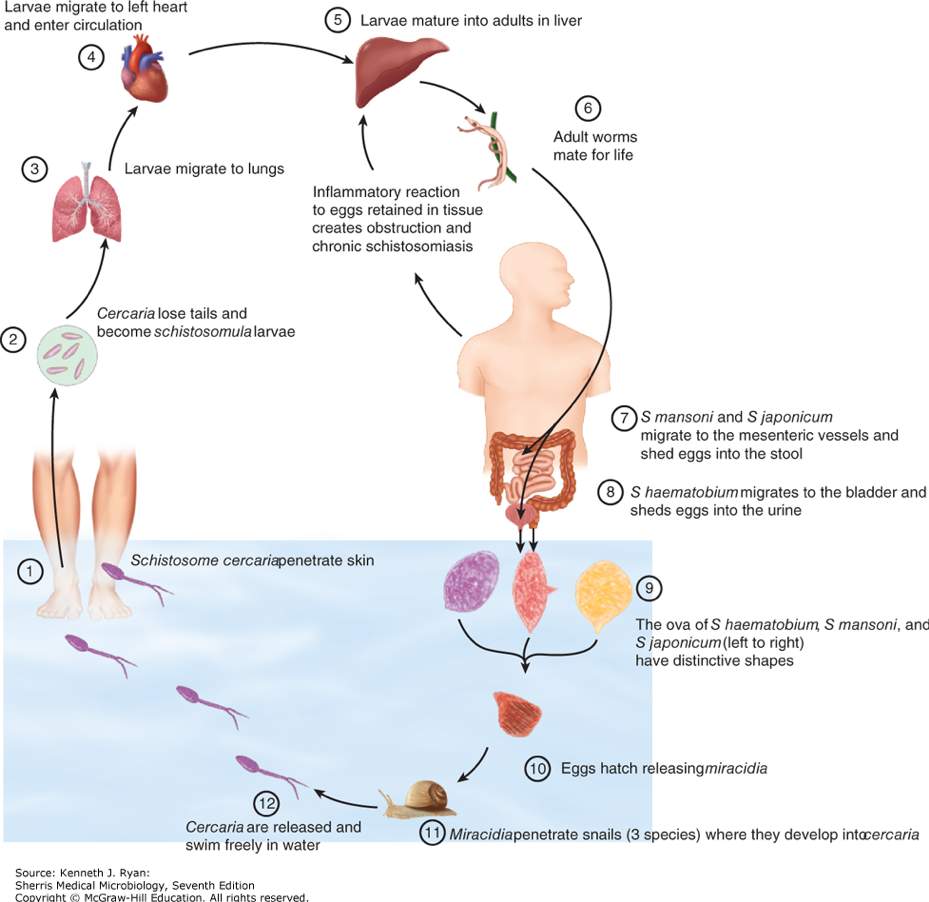
Human reservoir (or animal reservoir for some species) with snails in life cycle. Infection occurs when humans are in water and schistosomal cercariae (from snails) penetrate human skin. Cercariae form larvae that penetrate blood vessels and are carried to the liver where they become adults. The adults then migrate through portal vein to either mesenteric or urinary venules depending on the species. Adults lay eggs that penetrate mucosa and are passed into gut or urine respectively. Early symptoms with itchy rash after swimming, and later fever, lymphadenopathy, and allergic phenomenon related to migrating larvae (Katayama Fever). Eventually a few adult worms live in abdominal venous system for decades, laying eggs that cause liver, colon, or bladder disease. Eggs and adult worms induce localized inflammatory response that leads to the long-term sequelae: portal hypertension without cirrhosis, ileitis, colitis, bladder cancer.
- Dx: Stool and urine O&P are not sensitive tests for dx. Serology or biopsy helpful.
- Rx: Praziquantel.
(Africa, Middle East.)
Man is reservoir, presents with hematuria. Find eggs with terminal barb in a terminal urine sample. Fibrosis and calcifications of the bladder can lead to urinary obstruction and bladder cancer.
(Africa, Middle East, South America), S. japonicum (Asia).
Adult blood flukes live in the portal veins and lay eggs that travel to liver or lung causing inflammation and ultimately fibrosis (hepatic schistosomiasis). Children and adolescents present with hepatosplenomegaly related to the egg burden. Chronic hepatic schistosomiasis develops years later with portal hypertension, ascites, splenomegaly, esophageal varices and upper GI bleeding, and sometimes pulmonary hypertension. Liver function is preserved. Association with Salmonella bacteremia from bowel.
From bird schistosomes penetrating skin.
No further disease (similar pathogenesis to cutaneous larva migrans from dog hookworm).
See also in the Micro-ID session guide
Paragonimus (Lung fluke)
Humans ingest undercooked freshwater crab meat containing encysted larvae (metacercariae). In gut, immature flukes enter peritoneal cavity, burrow through diaphragm into lung parenchyma, and become adults. Eggs enter bronchioles and are coughed up or swallowed. Clinical symptoms include hemoptysis and clinical picture like TB, but with eosinophilia.
- Dx: Eggs visualized in sputum or feces.
- Rx: Praziquantel.
Clonorchis sinensis/Opisthorchis sinensis (Chinese liver fluke)
Life cycle with man/animals, snails and fish. Human infection from eating freshwater fish (second intermediate host). Adult flukes live up to 25 years in biliary tree and is generally asymptomatic, but can cause inflammation, and biliary obstruction with jaundice and ascending cholangitis (fever, chills, right upper quadrant abdominal pain). Up to 15 increased risk for cholangiocarcinoma (biliary tract cancer). In Thailand, nearly all cholangiocarcinomas develop in persons infected with Opisthorchis, usually by age 40–50.
- Dx by elevated serum alkaline phosphatase, biliary imaging showing obstruction, eggs in stool, and peripheral eosinophilia in 10–20%.
- Prevention: Thorough cooking or freezing of freshwater fish.
- Rx: Praziquantel.