


Parasitology 3: Ms. Freeman

Headshot of Joanna Breems, MD, FACP · Clinical Assistant Professor
Joanna Breems
MD, FACP · Clinical Assistant Professor
envelope icon phone icon

Case adapted from

Khosla A, Singhal S, Jotwani P, Kleyman R. Cerebral Toxoplasmosis As the Initial Presentation of HIV: A Case Series. Cureus. 2022 Mar 21;14(3):e23359. doi: 10.7759/cureus.23359. PMID: 35475054; PMCID: PMC9018902

Tap the arrow to view the case.
Ms. Freeman is 47-year-old woman brought to the emergency room by her siblings for bizarre behavior. She has been having auditory and visual hallucinations.

At home, she has been speaking insensibly and described a constant “knocking” inside her head. Her family notes that she was having similar symptoms in Liberia, before moving to her current home in Fargo, North Dakota, three weeks ago. The siblings are unaware whether any diagnosis or treatment was provided there. Otherwise, her medical history is notable for hypertension, and she has had limited primary care with no prior cancer screenings.
On examination, her temp is 102°F. She is awake, alert, and able to follow commands. There was a generalized tremor, and she had a new stutter. Cranial nerves, sensory, and motor exams were normal. A psychiatric evaluation demonstrated a disoriented and delirious demeanor, with a flat mood and an affect congruent to her mood. Her thought process was deemed illogical and not goal-directed, with loosening of associations.

Initial labs were normal except WBC 2.4, Sodium 132, and Potassium 3.2.
MRI findings: Contrast-enhanced MRI images for Case 2 showing multiple ring-enhancing lesions in the brain, with a large degree of surrounding vasogenic edema. Also observed are concentric alternating zones of hypo- and hyper-intense signals noted on both T2 and T1 sequences, namely “concentric target sign” (a) and (c) visualize the left frontal lobe lesion sized around 2.5 x 2.1 cm in axial and sagittal views, respectively; (b) is a sagittal view demonstrating a lesion in the right parietal lobe measuring 2.9 x 1.9 cm.

Questions for consideration

Read

Micro-ID Dendritics: Leishmania, Toxoplasma, Trichinella, Toxocara, and Schitosoma.

Watch

Toxoplasmosis

Transmission to humans

  • Ingestion of infected or contaminated food/water.
    • Oocysts in soil from cat feces.
    • Raw/undercooked meat.
  • Transplacental.
  • Blood transfusion or organ transplantation.


Tissue cysts remain latent in tissue.

  • Can reactivate during immunosuppression.

Adapted from RWJF Slides on Medically Important Protozoa. The predominant mode of transmission for Toxoplasma varies by region. For instance, in France raw/undercooked meat is the predominant mode. In Central America, stray cats shed oocysts that survive in soil. United States prevalence of seropositivity: 22.5%.

Congenital infection

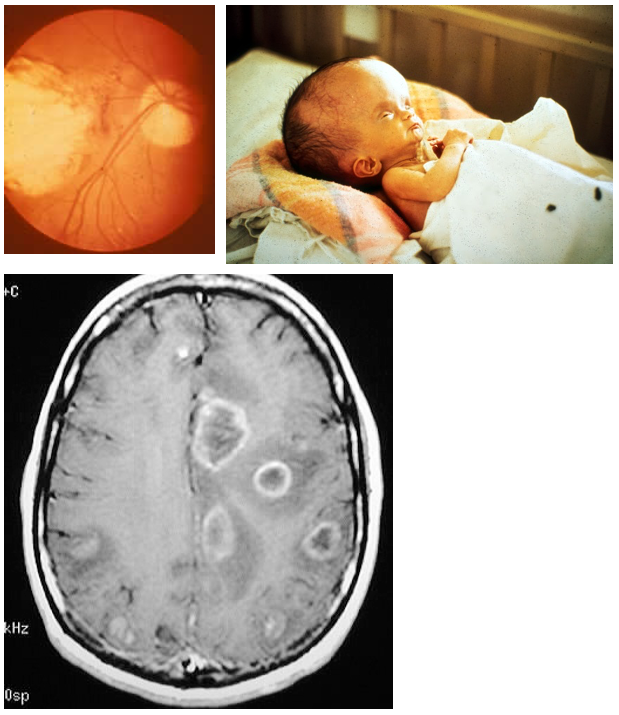
  • Hydrocephalus/intracranial calcification/chorioretinitis


Normal hosts

  • Asymptomatic > fever/lymphadenopathy.
  • Chorioretinitis.


Immunocompromised (HIV > others)

  • Ring-enhancing brain lesions.
  • Disseminated infection.


parasitology-toxoplasmosis-clinical-images
Adapted from RWJF Slides on Medically Important Protozoa Toxoplasma chorioretinitis image from Wikimedia Commons.

Presumptive Dx

  • Neurologic symptoms in patient with low CD4 (AIDS), ring-enhancing lesions in brain on CT scan and + serology.


Direct identification of organisms

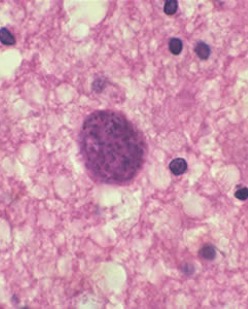
  • Tissue biopsy


Serologic testing

  • IgM for primary infection.
  • IgG for reactivation.


toxoplasmosis-diagnosis-histology-image
Cyst in brain tissue. Source: USGS.

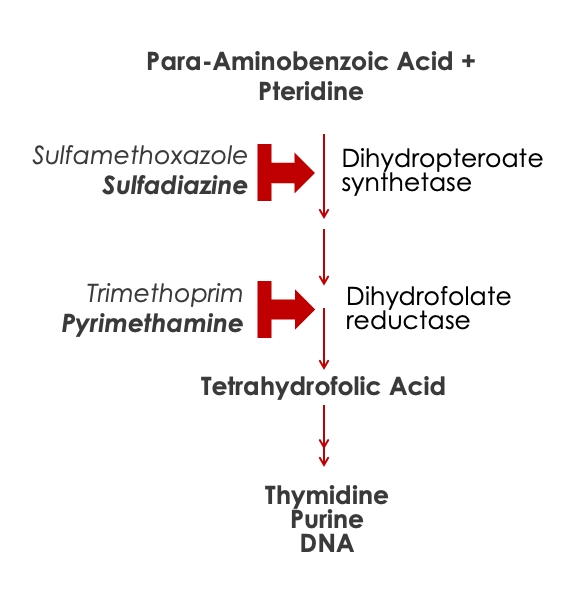
Pyrimethamine-sulfadiazine.

toxoplasmosis-treatment-graphic

HIV

  • (CD4 < 100) Prophylaxis with TMP-SMX if IgG+.

Pregnant women

  • Avoid cats and raw meat.

Micro: Tissue protozoa; disseminate and encyst.

Epidemiology: Oocysts from cat feces, or undercooked meat.

Clinical:

  • Congenital:
    • Hydrocephalus.
    • CNS calcifications.
    • Chorioretinitis
  • Normal Immunity:
    • Flu-like illness with adenopathy.
    • Chorioretinitis.
  • Immune Suppressed:
    • Seizures.
    • Ring-enhancing lesions on head CT.

Diagnosis: Mostly clinical dx; CT imaging; serology

Treatment: Pyrimethamine-Sulfadiazine.

Prevention:

  • Cook meat well.
  • Take care with cat feces.
  • TMP-SMX in AIDS.

Toxoplasma gondii can cause congenital defects and cysts in brain and other tissues that reactivate with immunosuppression.

Test your knowledge

Most likely, this patient acquired toxoplasmosis some time ago while in Liberia. Toxoplasmosis is most often acquired through the ingestion of the organism in contaminated soil, water, or food or in undercooked meat from an animal infected with Toxoplasma. Clear infection rates can be difficult to establish since most acute infections are asymptomatic, so seroprevalence is often used as a surrogate. Seroprevalence of Toxoplasmosis is higher in countries outside of the United States, with rates of seropositivity decreasing relative to economic development. Across all countries, seroprevalence increases with age likely correlating with cumulative exposure risk over time. 

Acute toxoplasmosis infection is often asymptomatic. When symptomatic, the most common manifestation is regional or generalized lymphadenopathy. When generalize symptoms (fever, malaise, headache) are present, the syndrome can mimic mononucleosis.

There are two infectious stages to humans:

  1. Oocysts: The product of sexual reproduction, which are excreted in the feces of the definitive host (felines). These structures are highly contagious and may remain viable in the environment for many years in the soil or water.
  2. Bradyzoites are the structures that form when a mammal is infected with oocysts that invade across the GI lumen and encyst in tissues. When this occurs in animals meant for food, undercooked meat containing bradyzoites infects the human.
  • Immunosuppression. In particular, advanced cell-mediated immunodeficiency related to AIDS is the most common risk factor for reactivation disease, manifested as CNS infection.
  • Developing fetuses also have limited immune response to Toxoplasmosis, and primary infection in a pregnant woman can lead to congenital toxoplasmosis (T in TORCH).

Image findings of Cerebral Toxoplasmosis and Neurocysticercosis have many overlaps and can manifest as “ring-like lesions” on CT and MRI.

In general, lesions of neurocysticercosis have a clear cystic structure (a “hole”) compared to Toxoplasma, which tends to be more mass-like. The peri-lesional edema (enhancement) is more variable in neurocysticercosis, with very old lesions without active organism having little to no ring-enhancement.

CNS Toxoplasmosis is classically associated with significant edema. Both agents can cause obstructive hydrocephalus. In the case of neurocysticercosis, this is due to a cyst physically obstructing outflow. In CNS toxoplasmosis, hydrocephalus is usually associated with massive edema.