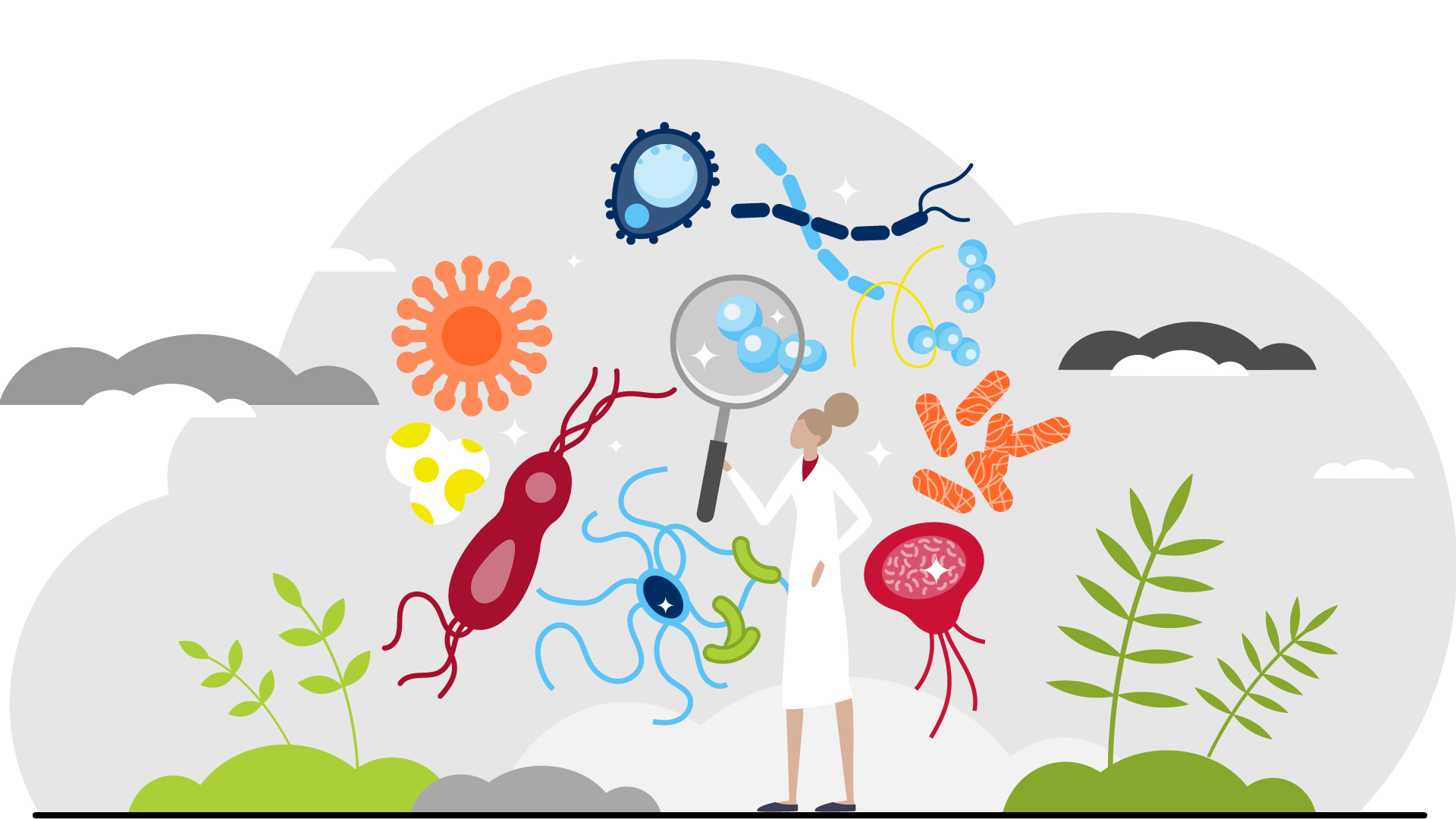


Welcome to Microbiology and Infectious Diseases! At WSU College of Medicine, you will learn about the medically relevant microbes and the diseases they cause in a longitudinal way: i.e., infections of the respiratory tract will be covered when you learn about the anatomy, physiology, and other diseases of the respiratory system.
- thread overview: “Orientation to the Microbiology and Infectious Disease Thread and WSU College of Medicine.”
You can find an overview of the thread and some tips and tricks for success in this topic in the following video.
This course is the bridge between the basic and molecular sciences that you have been engaging in, to date, and the clinically-oriented systems-based courses to come.
Our goals in this course are to facilitate your learning of the necessary foundational knowledge to apply to clinical infectious diseases. The faculty are primarily clinical infectious disease providers, which means we take care of patients and do research in infectious diseases; for the most part, we are not microbiologists.
There are two ways of looking at the relationships between microbes and human health. One is from the perspective of the microbes—how they are similar and how they are different; this is the basis of microbiology. The other side of the coin is looking at infectious diseases (e.g., pneumonia) and the variety of pathogens that could be the cause; this is the basis of clinical infectious diseases. Our course has been curated for the medical student. This means that faculty have chosen to present some material from perspective of microbiology at times and, at other times, from the perspective of clinical infectious diseases, to best optimize learning.
Resources for the component

This resource is intended to provide you with an organizational structure that the Micro-ID faculty believe to be the most useful for most students. There are basic details listed for the organisms that are meant to provide guidance to key features and serve as a memory aid. This is intended to be a reference compendium, not a complete text. Nor will content address all learning objectives assigned to the Micro-ID curriculum. There are links to session materials in which the organism/content was addressed in a curricular activity, for ease of access to the recommended reading and faculty slides. Links will be updated synchronously with sessions.
Material and resource guide for the Microbiology and Infectious Disease thread.
Microbiology and Infectious Disease reviews
Microbiology and Infectious Disease thread compendium
Microbiology and Infectious Disease thread session guides
- Gram-negative bacteria: Systemic and urinary pathogens (“The all stars”)
- Herpes virus
- Host-pathogen interactions
-
Introduction to bacteria: Classification and structure; virulence and pathogenicity
- Introduction to vaccines
- Introduction to viruses
- Meningitis and encephalitis
- Microbiome, normal flora, and antimicrobial stewardship
- Orbital eye infections
- Overview of microbes
Additional resources
-
Ryan Kenneth J. Sherris & Ryan’s Medical Microbiology. 8th ed. McGraw-Hill Education LLC.; 2022
Chapters contain an excellent level of detail for basic microbiology, and clinical information is accurate and succinct. Each chapter has a brief overview and Key Points in blue boxes, which are a great way to provide an outline for your study and let you choose which areas to take a deeper dive within the text.
-
Robert Wood Johnson Microbiology and Immunology Videos
Excellent video series by a collection of Infectious Disease experts nationwide. Does not provide complete curriculum for all pathogens or conditions covered in Micro-ID. Session guides will include most pertinent videos for the topic.
-
Guided voice-over sketches that are designed primarily for USMLE study and to make mnemonics for the many new pathogens and diseases you are being asked to learn. While many students find it very helpful as a memory aid, the material presented in Sketchy videos does contain some errors (trust your text or in-class material over Sketchy). As a memory aid alone, it does not always help in approaching case-based scenarios that you will see in exams. In short, it probably should not be your sole source of microbiology learning.
- Riedel S, Hobden JA, Miller S, et al., eds. Jawetz, Melnick & Adelberg’s Medical Microbiology. 28th ed. McGraw-Hill Education; 2019.
- Levinson W, Chin-Hong P, Joyce EA, Nussbaum J, Schwartz BS. Review of Medical Microbiology & Immunology : A Guide to Clinical Infectious Diseases. 17th ed. McGraw Hill Medical; 2022.
- A review book with shorter and to-the-point chapters. As the editor explains in the preface, the book has a twofold aim:
- Assist in USMLE Board prep.
- Provide brief and up-to-date information at a level appropriate for those beginning their medical education. Probably the easiest of the microbiology books to read. The last three sections (Clinical cases, Brief summaries of medically important organisms, and Clinical cases) contain concise, helpful information.
- A review book with shorter and to-the-point chapters. As the editor explains in the preface, the book has a twofold aim:
- Harrison TR. Harrison’s Principles of Internal Medicine. 21st edition. Editors, Joseph Loscalzo, Anthony Fauci, Dennis Kasper, Stephen Hauser, Dan Longo, J. Larry Jameson. (Loscalzo J, Fauci A, Kasper D, Hauser S, Longo D, Jameson JL, eds.). McGraw-Hill Education LLC.; 2022.
- One of the two best adult medicine textbooks (the other being Goldman-Cecil). Part 5 contains chapters on Infectious Diseases. This is a good way to see the contrast between microbiology as it is presented in Sherris and Clinical Infectious Diseases (how the patients will present to you as a physician).
- Bennett JE, Dolin R, Blaser MJ. Mandell, Douglas, and Bennett’s Principles and Practice of Infectious Diseases. 9th edition. Elsevier Inc.; 2020.
- The “bible” of Infectious Diseases—and just as long, maybe longer. Very thorough textbook geared to Infectious Disease specialists; you are not expected to know material to the depth of this text. However, you may have questions that are not answered well in the basic texts, and this would be the resource to turn to. Almost all chapters begin with a one-page Short View Summary where you can glean key points.