





In this session, we will assess a paper that is a case report on a patient with episodes of confusion and hypoglycemia. What was the diagnosis? Read the case report to find out! There will also be a short discussion on a case report and where it fits into the evidence-based pyramid.
- Learning Goals
- Learning activities
- Session Materials
- Required reading
- Describe different types of study designs and understand their strengths and weaknesses
- Describe the strengths and weaknesses of a case report about the Evidence-Based Medicine Pyramid
- Describe the goals and the various sections that are in a case report
- Activity 1: Discuss the different levels of the Evidence-Based Medicine Pyramid (10 minutes)
- Activity 2: Discuss the “Case Reports, Case Series: From Clinical Practice to Evidence-Based Medicine in Graduate Medical Education” Editorial (10 minutes)
- Activity 3: Critically appraise the article “Case 23-2018: A 36-Year-Old Man with Episodes of Confusion and Hypoglycemia” (30 minutes)
- Read the journal articles.
- Joanna Briggs Institute critical appraisal tool (under Case Reports).
- Wexler DJ, Macias-Konstantopoulos W, Forcione DG, Xiong L, Cauley CE, Pierce KJ. Case 23-2018: A 36-Year-Old Man with Episodes of Confusion and Hypoglycemia. N Engl J Med. 2018;379(4):376-385. doi:10.1056/NEJMcpc1802828
- Sayre, J., Toklu, H., Ye, F., Mazza, J., Yale, S. (2017). Case Reports, Case Series: From Clinical Practice to Evidence-Based Medicine in Graduate Medical Education. Cureus.
Activity 1: Discuss the different levels of the Evidence-Based Medicine Pyramid
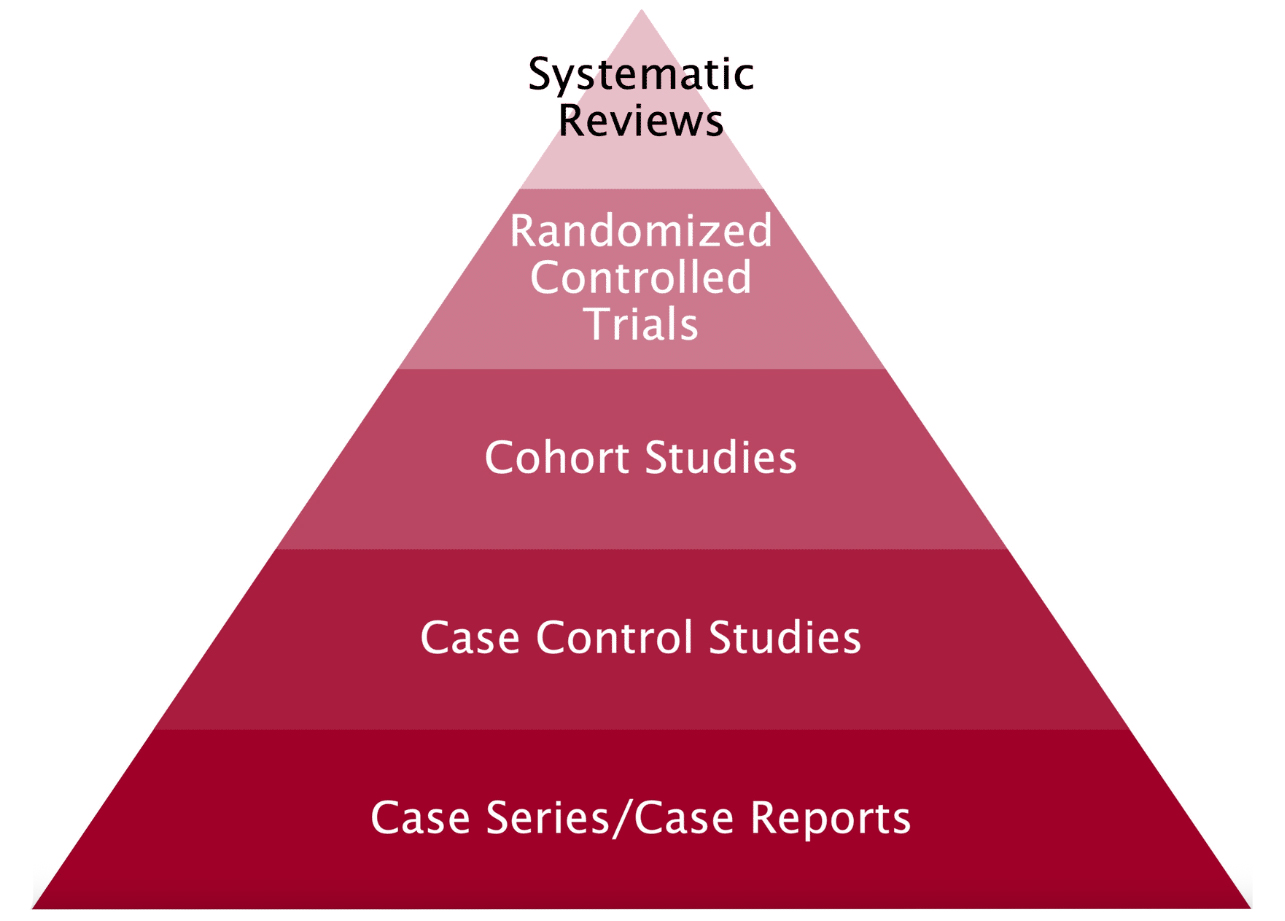
Not all evidence is considered equal. The Evidence-Based Medicine Pyramid is a diagram that helps us understand how to weigh different levels of evidence to make medical decisions. It puts the results of each study design into perspective based on each design’s relative strengths and weaknesses.
Discuss each type of study, and make sure you understand how they fit into the pyramid.
facilitators
Rigor increases in the studies as the pyramid builds toward the top.
Systematic search of literature based on pre-determined eligibility criteria and reproducible methodology.
-
- Advantages:
- Designed to limit bias.
- Results can be applied to the general population.
- May include statistical analysis.
- Disadvantages:
- It can be challenging to locate all relevant literature.
- High cost (i.e., time).
- Advantages:
Assignment to treatment and control groups determined through a random process.
-
- Advantages:
- Designed to limit bias.
- Can determine the cause of disease/condition.
- Statistical analysis of results.
- Disadvantage:
- Possible ethical issues.
- High cost.
- Loss to follow-up.
- Advantages:
Longitudinal observational study of two groups of interest: One which receives the exposure of interest and the other does not.
-
- Advantage:
- Examine multiple outcomes for a specific exposure,.
- Calculate rates of disease over time.
- Can assess causality.
- Disadvantages:
- Large numbers of subjects.
- Long duration for follow-up.
- No randomization.
- Advantage:
Two existing groups with different outcomes were identified and compared based on possible causal attribute.
-
- Advantages:
- Quick and inexpensive,.
- Study multiple risk factors.
- Can examine rare outcomes.
- Disadvantages:
- Recall bias or information bias.
- Hard to control for other variables.
- Cannot determine rates of disease/condition.
- Advantages:
Describes and interprets an individual patient’s case or an account of an activity, event, or problem.
-
- Advantages:
- Identify new diseases or trends.
- Rare instances of disease/condition.
- Share lessons learned.
- Disadvantages:
- Usually not generalizable.
- Not systematic.
- Unidentified variables.
- Advantages:
Activity 2: Discuss the “Case Reports, Case Series: From Clinical Practice to Evidence-Based Medicine in Graduate Medical Education” editorial
In this short editorial, the merit of case reports is considered.
Is there value to case reports in the context of EBM? Be prepared to defend your answer.
facilitators
Do case reports belong in “Evidence-Based Medicine"? This is a question that the students should have a lively debate about. It can be argued that there is no place for it in pure EBM form. However, as the evidence pyramid indicates, the case report's level represents the first stage of testing an observation. These studies are conducted in the early stages of research to help identify variables that might predict a condition.
Case reports help students remember topics much easier when they are attached to a patient story for undergraduate and graduate medical education.
- Advantages (from figure 2 in the article):
- One case to initiate a signal (case report).
- Provide more robust evidence with multiple cases (cases series).
- Observational.
- Educational.
- Easy to do (fast, and no financial support needed).
- Identify rare manifestations of a disease or drug.
- Disadvantages:
- No controls (uncontrolled).
- Difficult to compare different cases.
- Cases may not be generalizable.
- Selection bias.
- Unknown future outcome/follow-up.
Activity 3: Critically appraise the article using the checklist from the Joanna Briggs Institute
Note
The questions below in bold are from the JBI checklist along with a description of the questions. These questions are simple yes/no questions. However, expand on these questions with specifics and how they relate directly to the case.
facilitators
Does the case report clearly describe the patient’s age, sex, race, medical history, diagnosis, prognosis, previous treatments, past and current diagnostic test results, and medications? The setting and context may also be described.
Yes, the case report clearly describes the patient’s demographics. Some of those pertinent facts are:
- 36 year old.
- Male.
- Episodes of altered mental status and hypoglycemia.
- Eosinophilic esophagitis, which had been complicated by multiple episodes of food impaction that necessitated esophageal dilation.
- Sternotomy and laparotomy for a repair of an inferior vena cava injury after he had received an abdominal stab wound.
- No medications.
A good case report will clearly describe the history of the patient, their medical, family, and psychosocial history including relevant genetic information, as well as relevant past interventions and their outcomes.
The students should be able to note some of these, including:
- No family history of heart, pancreatic, or autoimmune disease.
- Some medical history is listed above, but there is a good discussion on the hypoglycemic events the patient had previously.
- BMI is considered a healthy weight.
- Alcohol use is noted, and there is a family history of alcohol use disorder.
The patient’s current clinical condition should be described in detail, including the uniqueness of the condition/disease, symptoms, frequency, and severity. The case report should also be able to present whether differential diagnoses were considered.
Differential diagnosis included:
- Hypoglycemia, due to:Hyperinsulinemia (autoimmune, factitious hypoglycemia).
- Insulinoma.
- Initial thoughts were:
- Viral encephalitis.
- Lyme encephalopathy.
- Neurosyphilis.
- Autoimmune cerebral vasculitis.
- Hepatic encephalopathy.
- Hashimoto’s encephalopathy.
- Vitamin B12 deficiency.
A reader of the case report should be provided sufficient information to understand how the patient was assessed. It is important that all appropriate tests are ordered to confirm a diagnosis, and therefore, the case report should provide a clear description of various diagnostic tests used (whether a gold standard or alternative diagnostic tests). Photographs or illustrations of diagnostic procedures, radiographs, or treatment procedures are usually presented when appropriate to convey a clear message to readers.
- CT and MRI.
- Endoscopic ultrasonography.
- Biobys and staining of the insulinoma.
- Bloodwork.
- Supervised fast.
- Urinalysis.
- Blood test.
- Testing for ketone bodies.
- And others. The students should pick up on the work-up that was done on this patient.
It is important to clearly describe treatment or intervention procedures, as other clinicians will be reading the paper and therefore may enable clear understanding of the treatment protocol. The report should describe the treatment/intervention protocol in detail; for example, in pharmacological management of dental anxiety—the type of drug, route of administration, drug dosage and frequency, and any side effects.
Surgical Resection of the Insulinoma.
A good case report should clearly describe the clinical condition post-intervention in terms of the presence or lack thereof symptoms. The outcomes of management/treatment when presented as images or figures would help in conveying the information to the reader/clinician.
The case report was very brief since the patient was better within two weeks.
With any treatment/intervention/drug, there are bound to be some adverse events, and in some cases, they may be severe. It is important that adverse events are clearly documented and described, particularly when a new or unique condition is being treated or when a new drug or treatment is used. In addition, unanticipated events—if any—that may yield new or useful information should be identified and clearly described.
None noted.
Case reports should summarize key lessons learned from a case in terms of the background of the condition/disease and clinical practice guidance for clinicians when presented with similar cases.
Although insulinomas are rare, this case report does an excellent job of describing the pathophysiology of this patient. Students should have a basic understanding of why hypoglycemia occurs in this patient and why the diagnostic tests were used. At this point, ask the students what their general thoughts are on this particular case report.