


Case Study 4: Stopped by a Tree

Headshot of Dawn Elise DeWitt, MD, MSc, CMedEd, MACP, FRACP, FRCP-London · Senior Associate Dean, Collaboration for InterProfessional Health Education Research & Scholarship (CIPHERS)
Dawn Elise DeWitt
MD, MSc, CMedEd, MACP, FRACP, FRCP-London · Senior Associate Dean, Collaboration for InterProfessional Health Education Research & Scholarship (CIPHERS)
envelope icon
Table of Contents

Case study 4: Olivia—Stopped by a tree

Tap the image to view the case.
A 21-year-old student on the WSU ski team presents after popping out of her ski while practicing on the race course. Her fall into a ravine was “stopped by a tree.” She hit the back of her head. She’s not sure if she lost consciousness briefly, but managed to ski down to the lodge. She has a headache and feels “wobbly” with difficulty focusing.

Question

The most important thing to do next is:

This is most likely mild traumatic brain injury. The definition includes trauma and a Glasgow Coma Scale of 13–15. While patients typically have neurological symptoms—e.g., confusion and headache (symptoms of “concussion”)—focal neurological findings point to a more serious brain injury. While a neuro exam is important, the first step is GCS.
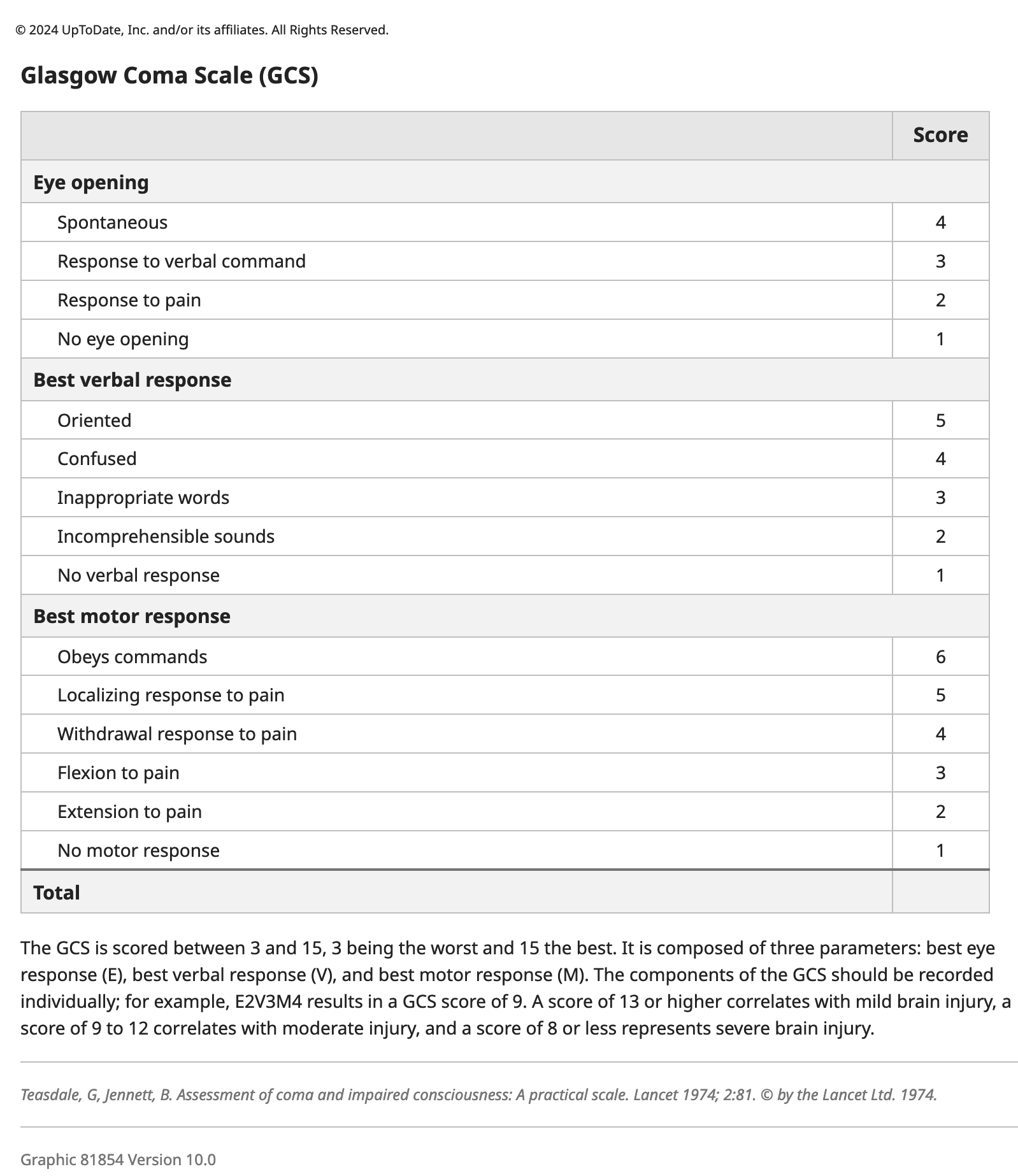
  • Patients with a GCS < 15 should be admitted for evaluation and observation for 24 hours.
  • Other indications for admission include bleeding risk and significant LOC or neurological findings.
  • A non-contrast CT scan to exclude skull fracture or bleeding is the first test if needed.
  • MRI is not a first-line test in most instances unless the patient has an obvious skull fracture on clinical examination—then an MRI may be a first-line test to distinguish SDH from EDH.
  • Rest for at least 24 hours with “observation” (someone to check on the person) is recommended. Return to school, work, or sports is dependent on function and risk. Return to sports while still symptomatic is not recommended, but prolonged “cognitive rest” is controversial.
  • See UpToDate: Sequelae.

Consequences of MTBI and chronic traumatic encephalopathy (CTE)

  • MTBI can result in “post-concussion syndrome” with many manifestations including cognitive issues, dizziness, headache, sleep disturbance, seizures etc.

  • Second impact syndrome”: Diffuse cerebral edema from a second injury while still symptomatic from the first is of high concern and protecting athletes or others at risk (military personnel, etc.) until symptoms from an MTBI incident have completely resolved without medication.

  • CTE is complex, but repeated MTBI, in particular, has been associated with early-onset dementia and higher rates of dementia, Parkinson Disease/PD symptoms, and ALS.

Image credits

Unless otherwise noted, images are from Adobe Stock.