


Neurological Exams Practice Cases

Headshot of Dawn Elise DeWitt, MD, MSc, CMedEd, MACP, FRACP, FRCP-London · Senior Associate Dean, Collaboration for InterProfessional Health Education Research & Scholarship (CIPHERS)
Dawn Elise DeWitt
MD, MSc, CMedEd, MACP, FRACP, FRCP-London · Senior Associate Dean, Collaboration for InterProfessional Health Education Research & Scholarship (CIPHERS)
envelope icon
Table of Contents

Patient 1: Emma—17-year-old girl with headaches

Tap the image to view the case.
Emma is a 17-year-old girl who comes into the clinic concerned about headaches. One-sided and throbbing, they last all day every 3–4 weeks. During these headaches, she feels sick to her stomach and vomits. She is especially concerned because sometimes her eyes go funny during these headaches. Emma's mother thinks she is spending too much time on technology (her phone, iPad, and computer). What do you think she has?

This is most likely a migraine headache. See the screening exam below.

Why practice (on anyone who will let you)?

  • So you’ll actually do it.
  • Do it the same way, in the same order, every time.


When?

  • When you clinically suspect there is little to find (e.g., confirmatory for tension headache).
  • When you are looking for gross abnormalities (e.g., sports physical; early diabetes physical; when admitting a patient to the ward for something else, but you should document the exam such as atrial fibrillation or chemotherapy where a stroke or peripheral neuropathy could become an issue).


My screening exam. Practice in the same order every time!

  • Interview: Language and speech.
  • Cranial nerves
    • “Grossly intact” vs. “in detail” = I paid careful attention vs. checking every nerve.
      • Document using these terms.
  • Fundoscopic exam.
  • Motor: Bulk, tone, and strength.
  • Sensory: Position, light touch, pin-prick/temperature.
  • Reflexes
  • Special: Cerebellar, coordination, tremor, gait.


Exam Technique Pearls

  • CNs-accommodation: Easier to see if you hold your finger at 2 feet then move it very quickly to 6 inches (pupils accommodate quickly).
  • Motor: Quick comparison of side-to-side.
  • Sensory: What to check and why, comparison.
    • The dreaded sensory level
      Learning dermatomes or knowing where to find them
  • Reflexes: Relaxation and augmentation
    • It’s all in the swing – hold hammer at the end loosely.
  • Romberg meaning? – It tests position sense.
  • Tremor: Put a piece of paper over the hands to detect fine tremor; cogwheeling = tremor + rigidity.
  • Gait: Watch for uneven gait and shuffling as the patient walks into the room or across the room.


Scale

Motor

5 = Normal

4 = Weak

3 = Can move against gravity

2 = Can move across gravity

1 = Flicker

0 = No movement


Reflexes

4 = Hyperactive

3 = Slightly Increased

2 = Normal

1 = Decreased

0 = Absent

Note: Hypothyroidism produces delayed recovery.

Patient 2: George—64-year-old man can't sleep

Tap the image to view the case.
A 64-year-old man comes to see you about his type 2 diabetes and osteoporosis. As you are talking, he says he can’t sleep because his hands burn. This started about a year ago, but now he can barely stand it. He has no diabetic complications (T2DM for 8 years) and takes metformin and insulin glargine daily. He drinks 2 glasses of wine with dinner most days.
  • Peripheral neuropathy. Most likely it is diabetic neuropathy or carpal tunnel (median nerve).
  • Alcohol neuropathy or B12 neuropathy (especially if the patient is on metformin or a proton-pump inhibitor) should be considered.


Neurological exam

  • Exam would include motor and strength testing of the upper extremities with comparison between the affected side and the unaffected side.
  • Phalen and Tinel signs may be helpful, though their usefulness is controversial—likelihood ratios are 1.3 and 1.5, respectively, but I find them clinically useful at times. (See McGee, EBM Physical Diagnosis, for details.)
  • Exam of the lower extremities for sensation, strength, and reflexes, as well as a complete diabetes foot exam, would be appropriate.

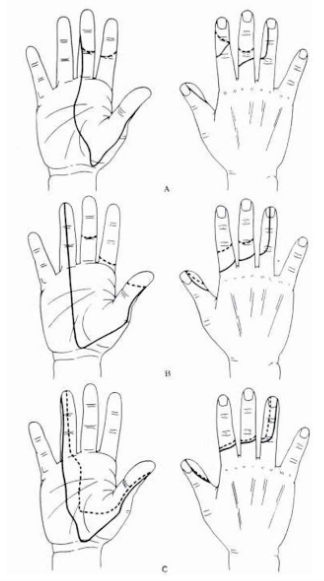
Approximate areas of sensory changes for median nerve lesions.

A = small area

B = average area

C = large area

Light touch: Continuous line

Pin prick: Dotted line


Modified from Head and Sherren (1905) Brain, 28, 116.
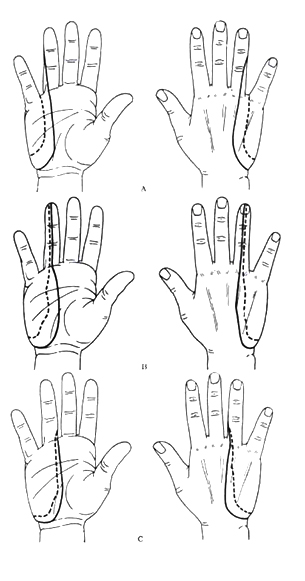
Approximate areas of sensory changes in ulnar nerve lesions. 

A = small area

B = average area

C = large area

Light touch: Continuous line

Pin prick: Dotted line


Modified from Head and Sherren (1905) Brain, 28, 116.
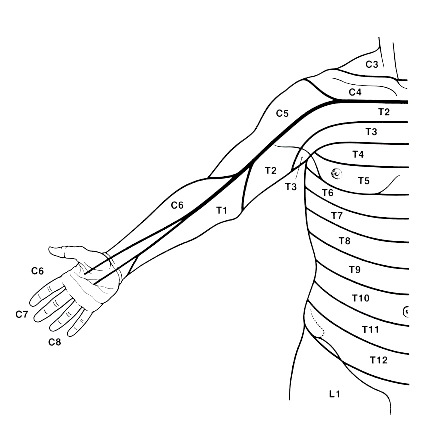
There is considerable variation and overlap.

This variation also applies to the innervation of the fingers, but the thumb is usually supplied by C6 and the little finger usually by C8 (see Inouye and Buchthal (1977) Brain 100: 731-748).
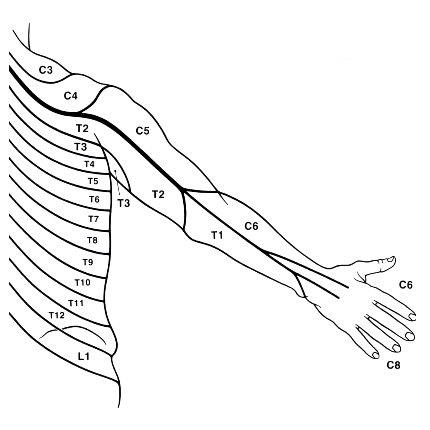
There is considerable variation and overlap.

This variation also applies to the innervation of the fingers, but the thumb is usually supplied by C6 and the little finger usually by C8 (see Inouye and Buchthal (1977) Brain 100: 731-748).

Patient 3: Darius—Days of fever and chills

Tap the image to view the case.
A 35-year-old man comes to the ED with 3 days of fevers and shaking chills. He has vomited once. He is worried because his back hurts terribly, and his legs feel like they are asleep, and he fell this morning getting out of bed to go to the toilet. He was incontinent of urine at the time. He has been healthy except for a car accident at age 18 that resulted in splenectomy. He had pneumovax at that time. Gram stain of his blood shows gram positive diplococci.

This is most likely cauda equina syndrome, which is a medical emergency and requires urgent surgical consultation.

  • Complete neurological examination of the lower extremities and a sensory level should be done, with comparison of strength, sensation, and reflexes to exclude a systemic disease process.
  • Peri-anal sensation and rectal tone are an important part of the examination for cauda equina.
  • You’re probably thinking that this exam is embarrassing; while that is true potentially for you and the patient, this is a life, or at least mobility-threatening condition, and I often will explain to the patient that if they feel embarrassed, I am happy to talk it through with them or to have a chaperone in the room, while doing everything possible to protect their privacy. I am always careful to explain both what I am doing and my findings as I go along.


Approximate distribution of dermatomes on the perineum
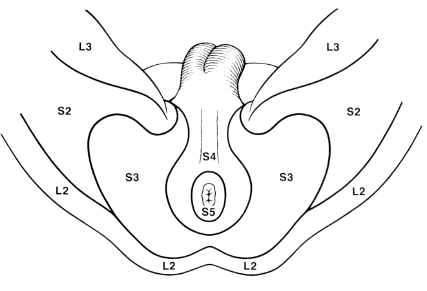
See Inouye and Buchthal (1977) Brain 100: 731–748.

Patient 4: Rachel—Recurrent low-back pain

Tap the image to view the case.
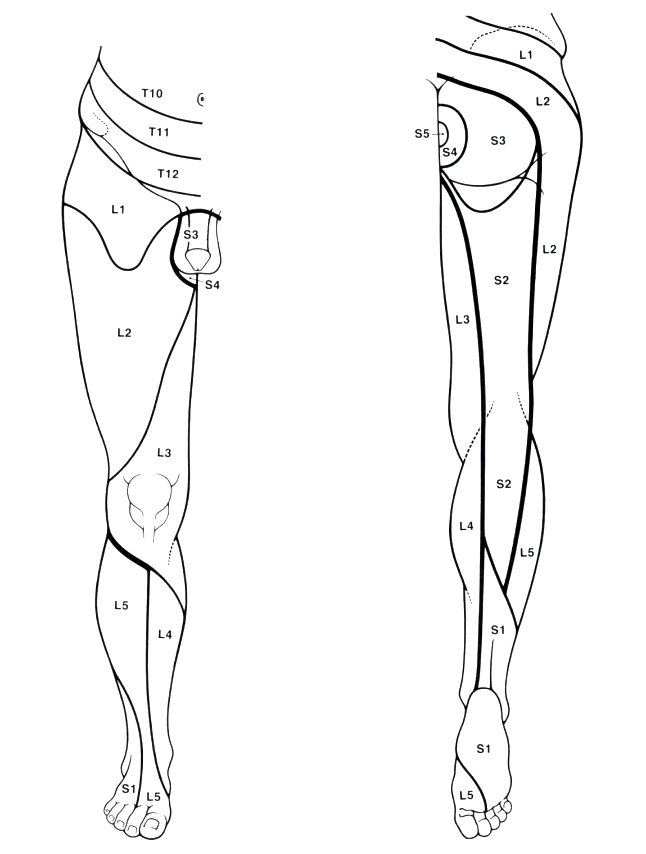
A 43-year-old telephone company linewoman comes in for recurrent low-back pain exacerbated by her job and gardening. The pain radiates down her left leg to her 4th and 5th toes.

Positive crossed straight leg raise.

Rationale
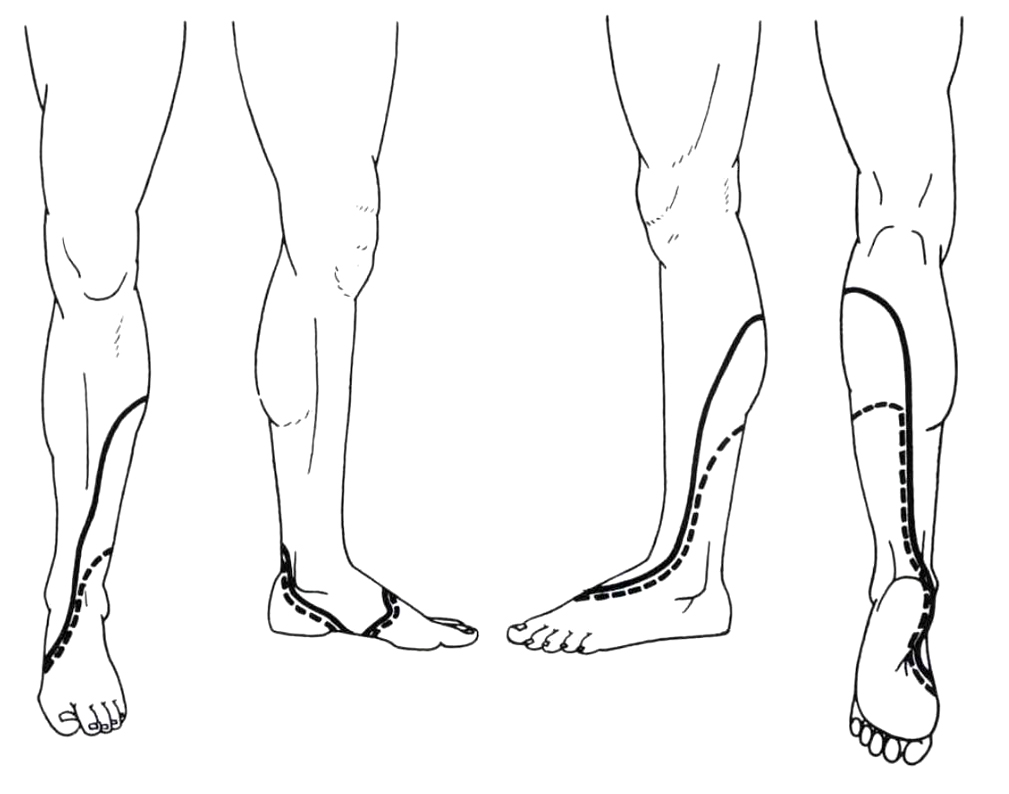
In this case, the answer options did not include ipsilateral calf wasting or weak ankle dorsiflexion. Therefore, a crossed straight leg raise is the most predictive of the answer options given. See likelihood ratios below. Note significant variation from person to person in sensory/dermatomal findings.

Findings that argue for disc herniation:
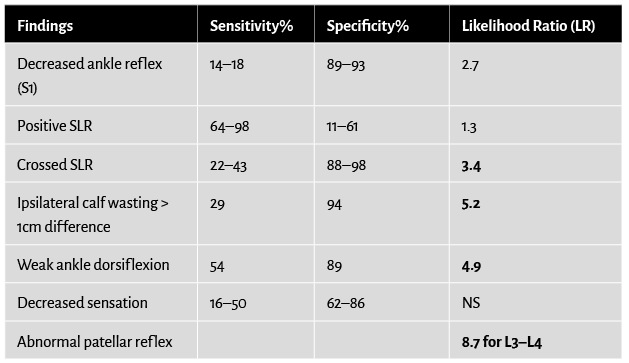
95% of patients with a “herniated” disc have “sciatica.” Deyo, Spine, 1997; McGee, EBMPD, 2007.

Light touch: Continuous line

Pin prick: Dotted line
Light touch: Continuous line

Pin prick: Dotted line
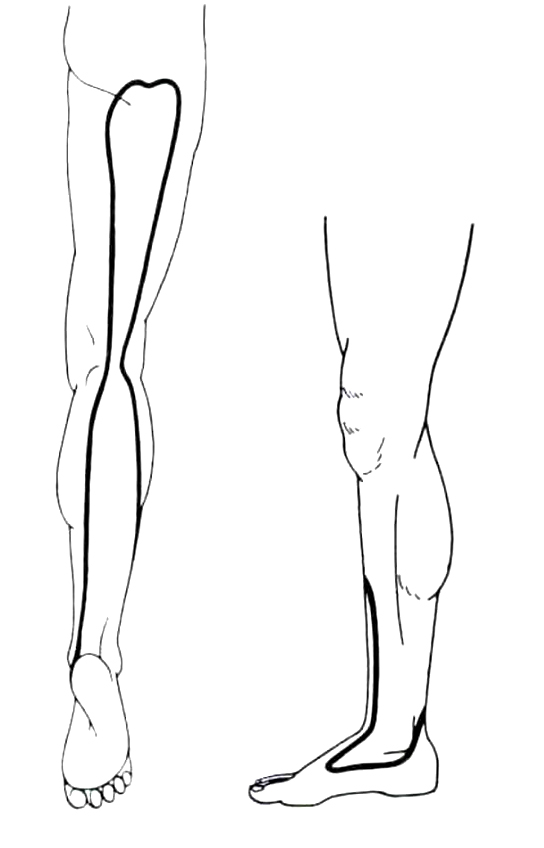
Approximate areas with considerable variation and overlap. (See Inouye and Buchthal (1977) Brain 100: 731–748.)
Find a partner or friend and practice your neuro exam!

Image credits

Unless otherwise noted, images are from Adobe Stock.