

Focal Seizures

Headshot of Dawn Elise DeWitt, MD, MSc, CMedEd, MACP, FRACP, FRCP-London · Senior Associate Dean, Collaboration for InterProfessional Health Education Research & Scholarship (CIPHERS)
Dawn Elise DeWitt
MD, MSc, CMedEd, MACP, FRACP, FRCP-London · Senior Associate Dean, Collaboration for InterProfessional Health Education Research & Scholarship (CIPHERS)
envelope icon

Abnormal electrical activity, at least initially, in one hemisphere of the brain (subcortical structures or neocortex); localizes to specific area on EEG or clinical findings. Often spreads bilaterally to become generalized.

Subtypes

Many different signs and symptoms, as above. Examples include:

    • Twitching or muscle jerks.
    • Changes in sensation:
      • Change in sense of smell (especially “burning smell” not observed by those around patient).
      • Change in sense of taste.
    • Numbness or tingling in certain areas of the body.
    • Muffling/distortion of sound, or ringing in one ear.

Categories

Simple focal seizures
Focal seizures without altered awareness or consciousness.
Complex focal seizures
Focal seizures with altered awareness or consciousness.
Secondary generalized seizures
Progression of a focal seizure to generalized tonic-clonic seizure.
Very common; may even be more common than bilateral-onset generalized seizures. 

First-time seizure

  • Without recurrence: Generally no treatment required if idiopathic; if provoked, address underlying cause.


Epilepsy (recurrent unprovoked seizures)

  • Anti-epileptic medication [preventative].
  • Generally started after two or more unprovoked seizures.
  • May not need life-long treatment.
  • Many drugs used to treat seizures have significant side effects, covered in the Medication tab.

Driving restrictions

  • Regulations vary by state.
  • In Washington, patients with an unprovoked seizure cannot drive for 6 months.

Broad spectrum

  • Focal and generalized-onset
  • Medications
    • Brivaracetam

    • Clobazam

    • Felbamate

    • Lamotrigine

    • Levericetam

    • Perampanel

    • Rufinamide

    • Topiramate

    • Valproate

    • Zonisamide

  •  Notable side effects: Very important!
    • Lamotrigine (Lamictal): Risk of Stevens-Johnson Syndrome.

    • Levetiracetam (Keppra): May cause severe behavioral issues at any point during treatment, even years later, e.g., aggression, agitation, depression, suicidality, and psychosis.

    • Valproate/valproic acid (“VPA”): Can cause  birth defects due to its effect on folic acid levels; requires folic acid supplementation. Diarrhea, nausea, weight gain, hair loss and tremor are other well-known side effects. 


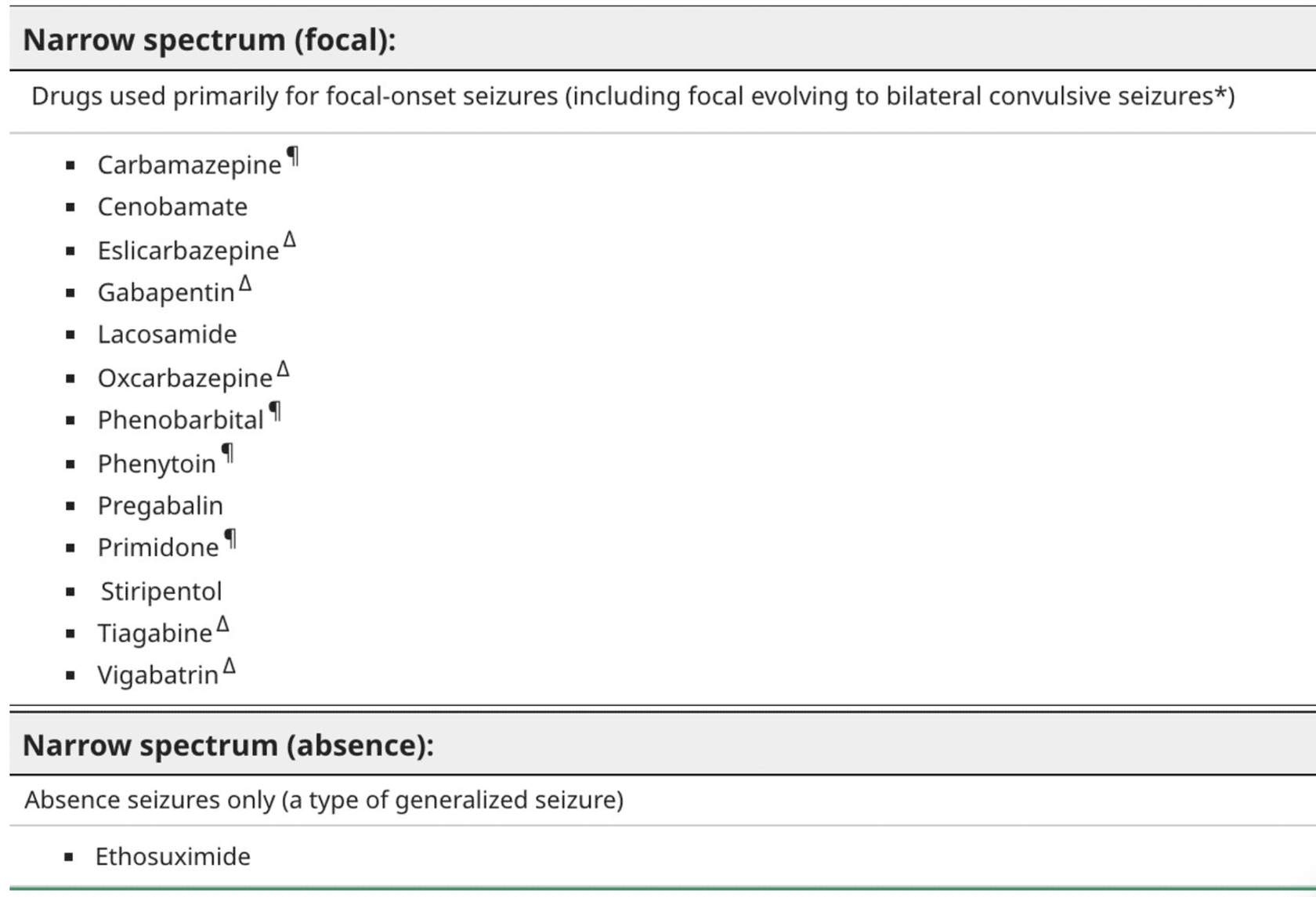
Narrow spectrum

  • Focal; Focal Generalized; Absence