



Case study 3: Ashley—Confused
Tap the image to view the case.
A 24-year-old woman is brought to the ED confused. She is incoherent when she speaks. Per EMS report, she had a generalized tonic-clonic seizure 15 minutes ago. Witnesses saw her pull her car to the side of the road and began to shake inside her car. While you are evaluating her, she begins to have another generalized tonic-clonic seizure that lasts for 2 minutes. She slowly regains consciousness and is confused but no longer actively seizing.
She had one prior unprovoked seizure approximately 2 months ago. Her chart lists bipolar disorder and obesity but is otherwise unremarkable. No family history of epilepsy. She does not take any medications, including no OCP. Vitals are stable.
She had one prior unprovoked seizure approximately 2 months ago. Her chart lists bipolar disorder and obesity but is otherwise unremarkable. No family history of epilepsy. She does not take any medications, including no OCP. Vitals are stable.
Question
What is the most appropriate next step in the management of the patient’s condition?
The patient meets criteria for status epilepticus and is at risk for serious cardiovascular and neurological complications. First-line treatment is IV benzodiazepine. While it is important to consider appropriate long-term seizure medications for the patient and potentially avoid valproic acid in a woman of child-bearing age and Keppra in a patient with a mood disorder, the patient needs acute treatment for her seizures now.
Criteria for Status Epilepticus
> (or equal to):
-
- 5 mins of continuous seizure activity (individual seizure).
- 2 discrete seizures between which there is incomplete return to baseline.
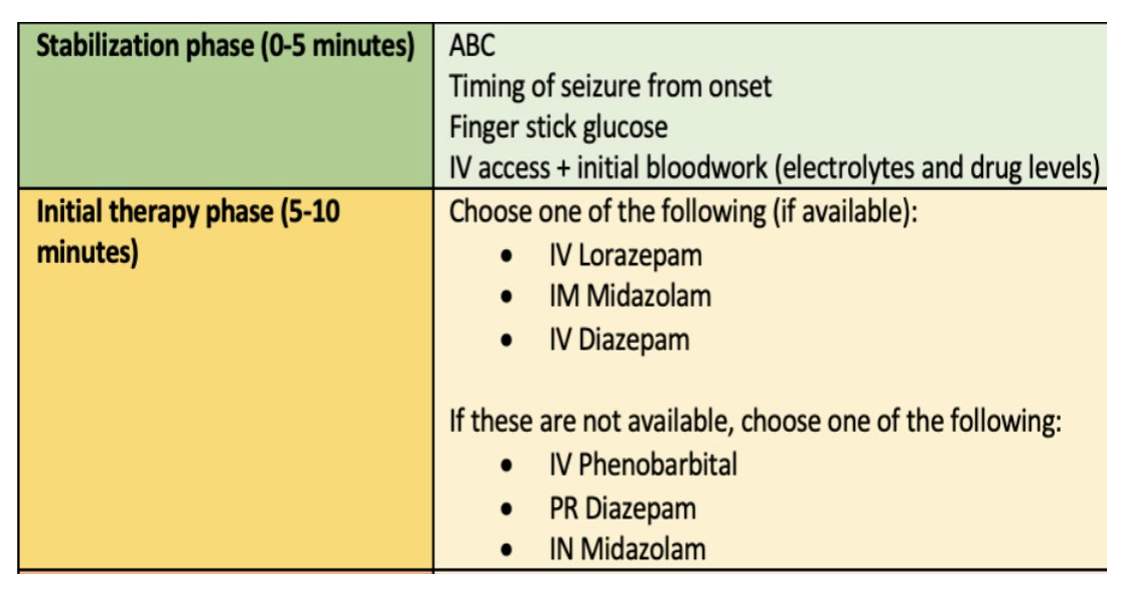
Image credits
Unless otherwise noted, images are from Adobe Stock.